Solar Street Light Battery Capacity Calculation Guide
Solar street light battery capacity calculation is one of the most important steps in solar lighting system design. If the battery is too small, the light may not provide enough runtime during…
Updated 2026-10-21 · 12 min read
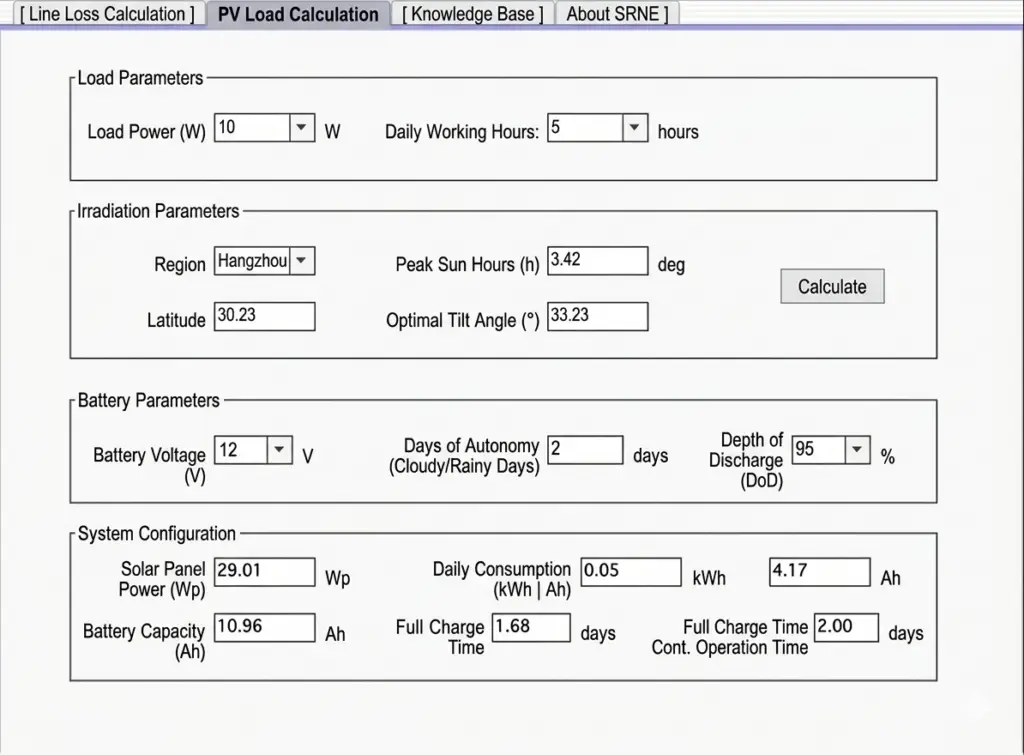
Solar street light battery capacity calculation is one of the most important steps in solar lighting system design. If the battery is too small, the light may not provide enough runtime during cloudy or rainy days. If it is too large, the total project cost increases unnecessarily. A proper battery capacity calculation should consider lamp wattage, daily working hours, backup days, system voltage, battery depth of discharge, system efficiency, and local solar resource conditions. This guide explains the full calculation logic, common engineering mistakes, and practical examples to help buyers and project contractors size batteries more accurately.
Key Takeaways
- Battery capacity should be calculated based on daily energy consumption, backup days, system voltage, depth of discharge, and system efficiency.
- In real projects, lithium batteries are now more commonly used than gel lead-acid batteries because of their lighter weight, smaller size, and easier installation.
- Backup-day requirements have a major impact on total battery size and project cost.
- Smart dimming strategies can significantly reduce battery capacity requirements and improve overall system cost efficiency.
- A professional solar street light design should consider not only battery capacity, but also solar panel charging capability, local climate, and long-term performance margin.
1. Why Battery Capacity Calculation Matters in Solar Street Light Design
Solar street lights work on a simple principle:
-
During the day, the solar panel generates electricity and charges the battery.
-
At night, the battery discharges and powers the LED luminaire.
This means the battery functions as the energy storage unit of the entire system. A properly sized battery should achieve three main goals:
-
Support normal nighttime lighting
-
Provide sufficient backup during consecutive cloudy or rainy days
-
Operate within a reasonable discharge range to protect battery life
A proper solar street light battery capacity calculation should always consider real project conditions rather than relying only on nominal wattage. If the design only considers whether the light can work for one night, many configurations may appear acceptable. However, in real outdoor projects, factors such as rainy seasons, dust, temperature variation, component aging, battery degradation, and controller loss all affect actual system performance. That is why battery capacity should always include a practical engineering margin.
A low-cost quotation may look attractive on paper, but if losses, autonomy requirements, and long-term degradation are not properly considered, the actual battery capacity may be far from sufficient.
2. Basic Formula for Solar Street Light Battery Capacity Calculation
The basic logic is straightforward: first calculate how much energy the lamp consumes per day, then calculate the required battery capacity based on backup days, system voltage, allowable depth of discharge, and system efficiency.
2.1 Standard Formula
Battery Capacity (Ah)=Daily Energy Consumption of Lamp (Wh)×Backup Days / (System Voltage (V)×Depth of Discharge (DOD)×System Efficiency)
Allowable depth of discharge must come from the selected battery datasheet and BMS settings. The worked examples below use 80% DOD as a reference assumption for LiFePO4, not a universal limit or a verified Qiyao battery specification. For a market reference, the Victron Lithium Smart datasheet lists cycle-life data at 80%, 70% and 50% DOD. Select the design value for the required service life and operating conditions.
2.2 Daily Energy Consumption Formula
Daily Energy Consumption (Wh)=Lamp Power (W)×Daily Working Time (h)
For example, for a 50W LED street light operating 10 hours per night:
50×10=500Wh
That means the lamp consumes 500Wh of energy per day.
3. Key Parameters That Affect Battery Capacity
3.1 Backup Days
Backup days refer to the number of consecutive cloudy or rainy days during which the system must still operate normally even when solar charging is very limited.
Typical reference values in the industry are:
2–3 days for areas with good sunshine conditions
3–5 days for general regions
5–7 days for rainy regions or projects with high reliability requirements
Not all projects need to be designed for 5 or 7 backup days. The final value depends on the project type, budget, and customer expectations. For example, rural roads, industrial park roads, temporary construction lighting, highways, and municipal main roads often have different autonomy requirements.
3.2 System Voltage
Common solar street light system voltages include:
- 3.2V
- 12V
- 24V
Low-power solar street lights, especially systems below 30W, often use 3.2V low-voltage systems. Medium- and high-power split solar street light systems more commonly use 12V or 24V.
Higher system voltage means lower operating current under the same power level, which helps reduce cable losses and improve system stability.
3.3 Depth of Discharge (DOD)
Depth of discharge is the proportion of nominal battery capacity discharged. Deeper discharge affects cycle life; the allowed operating range depends on the selected battery and BMS.
The examples in this article use 80% DOD for a LiFePO4 reference calculation. This is an assumed design input supported by specific market datasheets, not a limit shared by all lithium chemistries. Check the selected model, discharge cutoff, temperature and required cycle life before final sizing.
For example, if a battery is rated at 100Ah and designed at 80% DOD, its usable capacity is approximately:
100Ah×80%=80Ah
This is one reason why lithium battery systems are usually more compact than lead-acid systems at the same nominal capacity.
3.4 Why Lithium Batteries Are Now More Common
Today, most solar street light systems use lithium batteries rather than gel lead-acid batteries.
Although gel lead-acid batteries are stable, they are bulky and heavy. In many projects, they require a buried battery pit near the pole foundation, which increases installation complexity and makes maintenance inconvenient. They are also more vulnerable to theft and external damage.
Lithium batteries, by contrast, are smaller and lighter at the same usable capacity. They can be installed below the solar panel or mounted higher on the pole, making them easier to maintain and better for anti-theft and anti-vandalism protection.
3.5 System Efficiency
Not all electrical energy in the system can be transmitted without loss. Common losses come from:
Controller conversion loss
Cable loss
Battery charging and discharging loss
LED driver loss
Temperature effects
In practical engineering, system efficiency is often estimated at 0.85 to 0.95. For a more conservative design, many projects use 0.85 or 0.90.
4. Standard Calculation Example
This is a theoretical sizing example with assumed inputs; it is not a product rating or an approved project configuration.
Project Conditions
LED lamp power: 60W
Daily lighting time: 10 hours
Backup days: 3 days
System voltage: 24V
Battery type: LiFePO4 (reference example)
Assumed depth of discharge: 80%
System efficiency: 90%
Step 1: Calculate Daily Energy Consumption
60W×10h=600Wh
Step 2: Calculate Total Energy Demand for 3 Days
600Wh×3=1800Wh
Step 3: Convert to Battery Capacity
Battery Capacity=1800/(24×0.80×0.9)≈104.17Ah
This means the theoretical minimum battery capacity required is about 24V 105Ah.
Select an available battery configuration above the calculated minimum after allowing for temperature, aging, discharge limits and the complete project design.
This is because the theoretical calculation gives only the minimum requirement. In real projects, temperature derating, dust accumulation, insufficient charging, and battery aging should also be considered.
5. A More Practical Example for Common Projects
The next example addresses this question:
“For a 100W solar street light working 12 hours per night, what battery size is required?”
Known Conditions
-
Lamp power: 100W
-
Daily working time: 12h
Daily Energy Consumption
100×12=1200Wh
Assumptions
-
Backup days: 2 days
-
System voltage: 24V
-
Assumed LiFePO4 DOD: 80%
-
System efficiency: 90%
Calculation
Battery Capacity=1200×2/(24×0.90×0.80)≈138.89Ah
The theoretical minimum before additional design margins is approximately:
24V 139Ah (rounded up)
If the customer requires 3 backup days, then:
Battery Capacity=1200×3/(24×0.90×0.80)≈208.33Ah
The theoretical minimum for three backup days, before additional design margins, is approximately:
24V 209Ah (rounded up)
This example clearly shows that each additional backup day significantly increases battery size and cost. That is why autonomy requirements must always be confirmed before preparing a quotation.
6. Why Theoretical Formula Alone Is Not Enough
6.1 Full-Power Operation vs Smart Dimming
Many solar street lights do not operate at full power throughout the night.
A common control strategy is:
First 5 hours at 100% brightness
Next 5 hours at 50% brightness
In that case, the actual energy consumption is not:
50W×10h=500Wh
but:
50W×5h+25W×5h=375Wh
This kind of time-control and power-reduction strategy can significantly reduce the required battery size and overall system cost.
6.2 Local Solar Resource Conditions
The same 60W street light may require different configurations in the Middle East, Africa, Southeast Asia, southern China, or northwestern plateau regions. This is because different project locations have different:
Peak sunshine hours
Probability of continuous cloudy weather
High- and low-temperature conditions
Dust, salt spray, and humidity levels
In practical project design, local solar irradiation data should be checked using reliable resources such as the Global Solar Atlas.
That is why solar panel sizing and battery sizing should always be considered together.
6.3 Different Battery Types Require Different Design Approaches
The most common battery types for solar street light systems include:
Gel lead-acid batteries
Ternary lithium batteries
Lithium iron phosphate (LiFePO4) batteries
Among them, LiFePO4 and ternary lithium batteries are now more widely used in outdoor projects because they offer:
Longer cycle life
Higher allowable depth of discharge
Smaller size
Lower weight
Better temperature adaptability
Easier maintenance
However, the use of lithium batteries does not mean the battery capacity can be reduced arbitrarily. Many low-cost systems reduce capacity too aggressively, resulting in poor long-term reliability.
7. Common Mistakes in Solar Street Light Battery Sizing
7.1 Sizing the Battery Only by Lamp Wattage
Some quotations estimate battery size only from nominal lamp wattage, without checking daily lighting hours or backup-day requirements.
This is risky because:
50W×6hand 50W×12h
represent two completely different energy demands.
7.2 Ignoring System Losses
If the theoretical energy demand is 600Wh, it does not mean the battery only needs to provide 600Wh. Actual system losses increase the real required battery output.
7.3 Confusing Nominal Capacity with Usable Capacity
A 100Ah battery does not necessarily provide 100 Ah of usable capacity. Usable capacity depends on battery type, DOD, and operating temperature.
7.4 Focusing Only on Initial Cost
Some buyers try to minimize upfront cost by reducing battery capacity. However, frequent deep discharge often shortens battery life and increases later replacement and maintenance cost.
8. Practical Engineering Recommendations
8.1 Small Projects or Budget-Sensitive Projects
For smaller projects, the design can be optimized, but the following must be clearly defined:
Required lighting hours
Power output level
Backup-day requirement
Whether the customer accepts reduced runtime in extreme weather
8.2 Standard Municipal or Industrial Park Projects
For standard projects, it is safer to:
Reserve a reasonable battery margin
Prefer lithium batteries
Use intelligent controllers to reduce late-night power consumption
8.3 High-Reliability Projects
For major roads, key public areas, and overseas government projects, it is recommended to:
Avoid selecting the battery exactly at the theoretical minimum
Use a higher standard for backup days
Check solar panel charging recovery capability
Include temperature, dust, and aging factors in the design margin
9. Battery Capacity Is Not an Isolated Parameter
Solar street light design involves more than panel size, battery capacity, and lamp wattage.
In reality, battery capacity should always be evaluated together with:
-
LED power
-
Daily operating time
-
Intelligent dimming strategy
-
Backup-day requirement
-
Battery type
-
System voltage
-
Solar panel charging capability
-
Local climate conditions
A professional solar street light solution is not just about quoting an “XXAh battery.” It is about presenting a complete and balanced energy design.
10. Conclusion
The goal of solar street light battery capacity calculation is not to maximize every parameter. The real objective is to balance stability, battery life, and project cost.
A practical design workflow is:
-
Calculate the daily energy consumption of the lamp
-
Calculate total demand based on backup days
-
Convert that demand into battery capacity using system voltage, DOD, and efficiency
-
Adjust the result according to climate, control strategy, and engineering margin
In simple terms:
-
If battery capacity is too small, the system becomes unreliable
-
If battery capacity is too large, the project becomes less economical
-
Only a properly calculated configuration is truly suitable for the application
Whether the project is for rural roads, industrial parks, municipal streets, or overseas infrastructure, careful battery calculation during the design stage is always better than discovering later that the lighting time is not enough during cloudy or rainy periods. In real projects, accurate solar street light battery capacity calculation helps balance lighting performance, battery life, and overall system cost.
If you are planning a solar street lighting project, you can explore our Solar Street Lighting Solutions page for more design guidance and product options.
Project Information Checklist
Send the following details for a faster and more accurate solar street light quotation:
Before treating the result as a purchasing specification, review battery comparisons beyond amp-hours and the complete solar lighting energy balance. Bring the location, required night program, reserve assumptions and proposed components to the solar street light purchasing page. Request a configuration-based quotation that identifies the battery, panel, controller and operating schedule being offered.
- Project location (city/country)
- Required lamp wattage and daily working hours
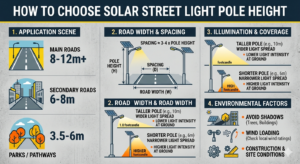
- Pole height, pole spacing, and quantity
- Required backup days (autonomy days)
- Average sunshine hours or local solar irradiation data
- Required lighting standard or brightness expectation
- Whether poles, brackets, or foundations are included
- Shipping destination port
Existing article product links
Related Products
Article-specific FAQ
What is the basic formula for solar street light battery capacity calculation?
The common formula is:
Battery Capacity (Ah)=Daily Energy Consumption (Wh)×Backup Days / (System Voltage (V)×DOD×System Efficiency)
Is a larger battery always better for solar street lights?
No. An oversized battery increases cost unnecessarily. The right capacity should match project requirements, autonomy days, and charging conditions.
Why are lithium batteries more popular than gel lead-acid batteries?
Lithium batteries are lighter, smaller, easier to install, and generally easier to protect against theft and vandalism. They also allow higher usable discharge in many applications.
How many backup days should a solar street light system have?
It depends on the project location and reliability requirement. In practice, 2–3 days, 3–5 days, or even 5–7 days may be used.
Does dimming affect battery capacity selection?
Yes. Smart dimming can reduce daily energy consumption and therefore reduce the required battery size.
Related Guides
Need a Fast Engineering Quotation?
Send the project location, required night program, quantity, shading conditions and available component information. Our team can review the requested configuration and prepare a project-specific quotation. Confirm the battery, panel, controller, supply scope and delivery requirements with the offer.