Solar Street Light vs Traditional LED Street Light: Which Is Better for Your Project?
When planning an outdoor lighting project, one of the most common questions is this: solar street light vs traditional LED street light—which is the better option? Whether the application is a municipal…
Updated 2026-10-21 · 20 min read
When planning an outdoor lighting project, one of the most common questions is this: solar street light vs traditional LED street light—which is the better option? Whether the application is a municipal road, rural road, industrial park, residential street, parking lot, or newly developed area, the lighting system you choose will directly affect initial investment, installation complexity, maintenance requirements, and long-term operating cost.
At first glance, both solar street lights and traditional grid-powered LED street lights can provide effective road illumination. However, they differ significantly in power supply method, installation approach, application environment, maintenance logic, and lifecycle cost. For project buyers, contractors, developers, and government clients, the real question is not which one is universally better, but which solution is better suited to the actual project conditions.
This article provides a systematic comparison of solar street light vs traditional LED street light from the perspectives of system structure, working principle, project cost, construction requirements, maintenance needs, application scenarios, and long-term value. The goal is to help engineering buyers and infrastructure decision-makers choose a more suitable road lighting solution.
Key Takeaways
- Solar street lights are independent systems powered by solar energy, while traditional LED street lights rely on the electrical grid.
- Solar street lights often reduce cabling and electricity costs, especially in remote or weak-grid areas.
- Traditional LED street lights are usually more suitable for urban roads and projects that require high-power, highly stable illumination.
- The right choice should be based on project location, grid access, climate conditions, lighting standards, and lifecycle cost.
- For professional road lighting projects, comparing only product price is not enough. Total project cost and long-term performance matter more.
1. Why This Comparison Matters in Modern Road Lighting Projects
In modern infrastructure development, lighting selection is no longer only about brightness. Project owners also care about energy efficiency, installation convenience, maintenance burden, power availability, carbon reduction goals, and long-term return on investment.
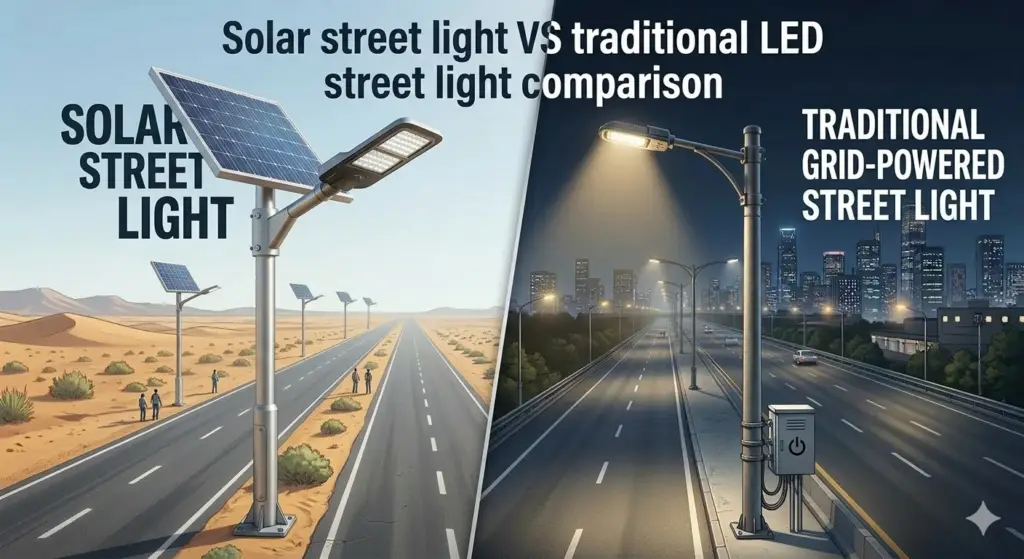
That is why the comparison between solar street light vs traditional LED street light has become increasingly important. In some regions, especially remote roads, villages, desert areas, coastal zones, and newly developed districts, solar street lights can solve the problem of limited grid access. In established urban areas with complete electrical infrastructure, traditional LED street lights may still remain the more practical option.
A professional comparison helps buyers avoid choosing a system based only on initial unit price. In real engineering work, the better solution is the one that fits the project environment, technical requirements, and long-term budget strategy.
2. What Is a Solar Street Light?
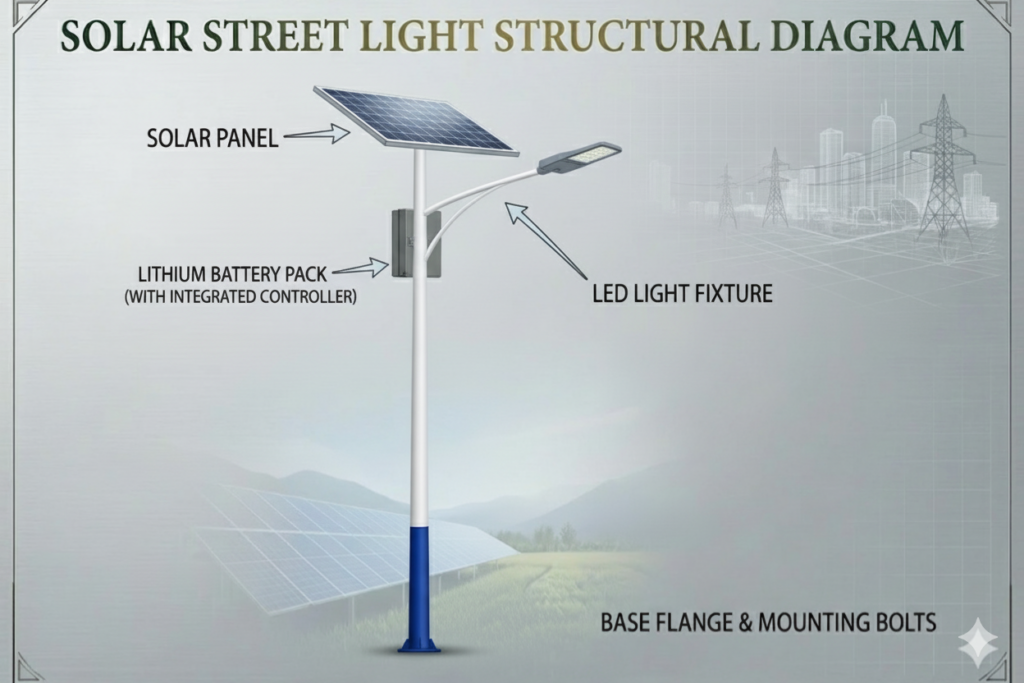
A solar street light is an outdoor lighting system that generates electricity from solar energy and operates independently from the utility grid. A standard system usually includes the following components:
-
Solar panel
-
LED luminaire
-
Battery
-
Smart controller
-
Pole and mounting structure
The working principle is straightforward. During the day, the solar panel converts sunlight into electricity. The battery stores this energy for nighttime use. After sunset, the controller automatically powers the LED luminaire using the energy stored during the day.
This closed-loop energy system does not need a municipal power connection. Each light can operate as a relatively independent unit. Because of this, solar street lights are especially suitable for:
-
Remote area road lighting
-
Rural and village roads
-
Mountain, island, and scenic area roads
-
Temporary construction roads
-
New development zones without complete grid infrastructure
-
Public projects with clear energy-saving or sustainability targets
All-in-One Solar Street Light
All-in-One Solar Street Light systems integrate the LED luminaire, battery, controller, and panel structure into a compact unit.
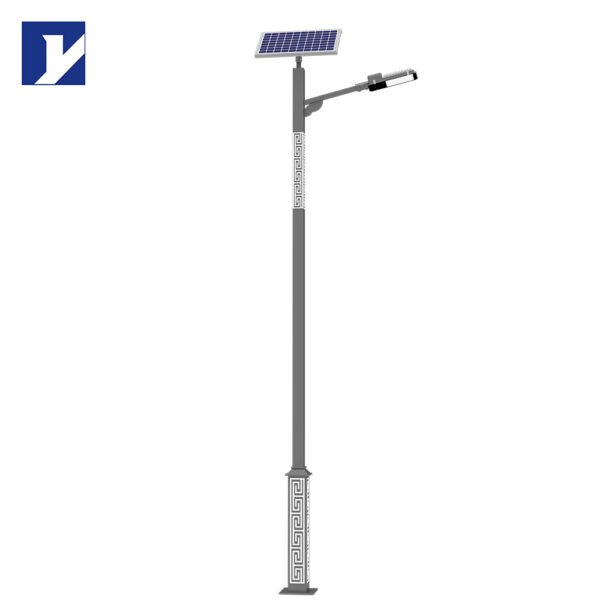
In an all-in-one solar street light, the solar panel, battery, controller, and LED luminaire form an integrated unit. This design offers a clean appearance, convenient installation, and lower installation complexity. It is usually suitable for small to medium power applications.
Split-Type Solar Street Light
In a split-type design, the solar panel, battery, and luminaire are installed separately. This provides greater flexibility in configuration and is more suitable for higher wattage projects, demanding operating conditions, and applications with stricter performance requirements.
For overseas road lighting projects, solar street lights are no longer just an energy-saving alternative. In many markets, they have become a mature mainstream solution. This is especially true in regions such as the Middle East and Africa, where strong solar resources make solar-powered road lighting highly attractive.
3. What Is a Traditional LED Street Light?
A traditional LED street light refers to a road lighting system powered by the electrical grid rather than by solar energy. It usually includes:
-
LED street light luminaire
-
Pole
-
Arm or bracket
-
Electrical cables
-
Distribution system
-
Control cabinet, transformer, or other power access facilities
Unlike solar street lights, traditional LED street lights require connection to the local power network. Electricity is supplied continuously through underground cables or overhead lines.
The main advantages of this system are power stability, technical maturity, and strong compatibility with existing urban infrastructure. For this reason, traditional LED street lights are still widely used in municipal roads, urban main roads, commercial areas, industrial parks, and large transportation projects.
It is also important to clarify that “traditional street light” today does not necessarily mean old sodium or metal halide lighting. In many modern projects, the luminaire itself is already LED. The difference is that the power source is still the grid, not solar energy.
So in this article, traditional LED street light specifically means a grid-powered LED road lighting system.
4. Solar Street Light vs Traditional LED Street Light: Key Differences
From an engineering and project application perspective, the difference between solar street lights and traditional LED street lights mainly appears in the following aspects.
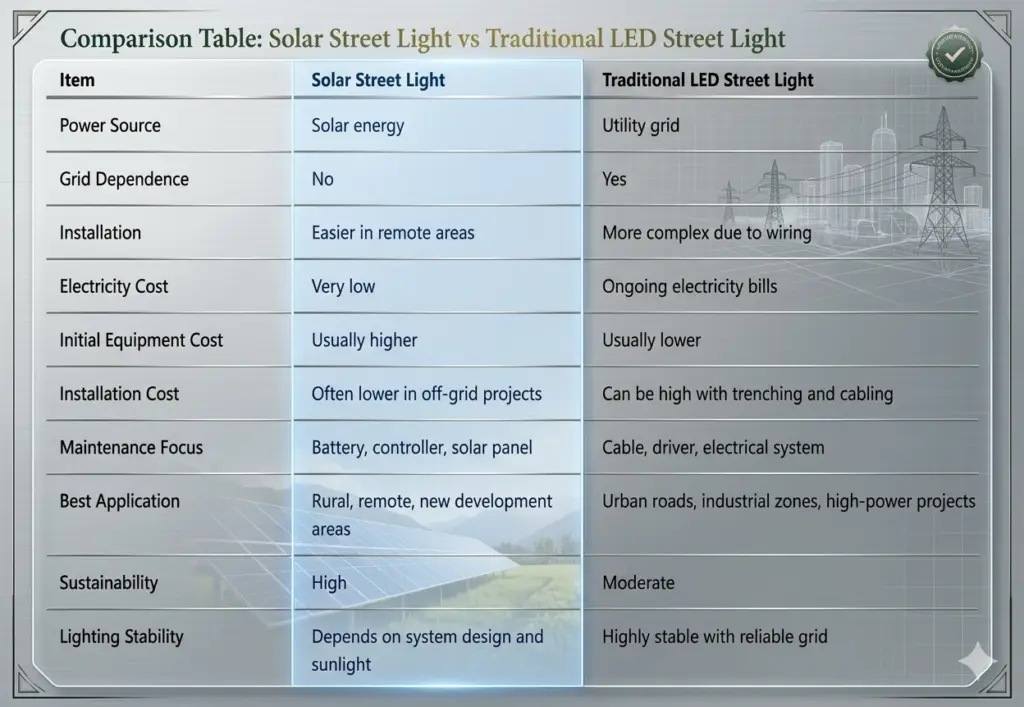
4.1. Power Supply Method
-
Solar street lights generate electricity from solar energy and work independently.
-
Traditional LED street lights depend on the utility grid for continuous power supply.
This difference directly affects installation method, operating cost, maintenance logic, and application suitability.
4.2. System Structure
A solar street light is a relatively independent system. Each light typically integrates power generation, energy storage, control, and lighting functions.
A traditional LED street light depends much more on external electrical infrastructure. Its complete operation relies on cables, power distribution, transformers, and centralized electrical control systems.
4.3. Installation Method
Solar street lights usually do not require large-scale trenching or long-distance underground cable laying.
Traditional LED street lights often require:
-
Trench excavation
-
Cable laying
-
Conduit installation
-
Power distribution connection
-
Electrical safety and leakage protection measures
As a result, in remote or weak-grid areas, traditional LED street light installation may become much more expensive and complicated.
4.4. Operating Cost
After installation, solar street lights generally do not generate continuous electricity bills.
Traditional LED street lights, however, consume grid electricity throughout their operating life. In projects with many lighting points and long nightly operating hours, this becomes a significant long-term expense.
4.5. Maintenance Logic
Solar street light maintenance usually focuses on:
-
Battery health
-
Solar panel cleanliness
-
Controller performance
-
Charging and discharging efficiency
Traditional LED street light maintenance usually focuses more on:
-
Cable faults
-
Electrical system safety
-
Distribution equipment maintenance
-
Luminaire and line inspection
4.6. Dependence on Environmental Conditions
Solar street light performance is influenced by local sunshine hours, rainy weather, seasonal variation, and solar radiation conditions. Therefore, solar system design must be based on local climate data.
Traditional LED street lights are less sensitive to weather conditions. As long as the grid is stable, the lighting system can continue to operate normally.
5. Main Advantages of Solar Street Lights
Solar street lights are becoming more popular in new road lighting projects because they offer clear practical benefits under suitable project conditions.
5.1. No Long-Term Electricity Bills
Solar street lights use solar energy instead of grid electricity. Once installed, they usually do not create normal electricity costs. For projects with many lighting points and long service life, this can significantly reduce long-term operating expenses.
5.2. Better for Off-Grid or Weak-Grid Areas
In many rural areas, mountains, islands, mining zones, desert areas, and new development zones, connecting to the power grid can be difficult or expensive. It may require transformers, long cable runs, and supporting electrical infrastructure. In such cases, solar street lights often provide a more practical solution.
5.3. More Flexible Construction
Solar street lights usually do not require large-scale excavation or underground wiring. This means:
-
Shorter possible construction periods
-
Less civil work support
-
Less damage to existing roads and surfaces
-
Easier installation in complex terrain
5.4. Energy Saving and Environmentally Friendly
As global infrastructure projects increasingly emphasize sustainability, carbon reduction, and green development, solar street lights naturally fit these goals. This is especially attractive for government projects, development programs, and ESG-focused infrastructure investment.
5.5. Independent Operation
Most solar street lights operate as stand-alone units. If one light fails, it usually does not cause the whole lighting line to go dark. Compared with centralized power systems, this distributed structure can offer better fault isolation in certain applications.
5.6. Strong Smart Control Integration
Modern solar street lights can often integrate:
-
Time control
-
Light control
-
Motion sensing
-
Dimming by schedule
-
Intelligent energy-saving strategies
These functions can improve battery autonomy and overall system efficiency.
6. Main Advantages of Traditional LED Street Lights
Traditional LED street lights also offer advantages in many projects.
6.1. Strong Power Stability
As long as the local electrical grid is reliable, traditional LED street lights can provide stable and continuous lighting performance. There is no need to worry too much about continuous rainy days, insufficient winter sunshine, or battery storage limitations. This is especially important for projects with high lighting standards and long daily operating hours.
6.2. Better for High-Power and High-Illumination Projects
Some applications require higher wattage, stronger continuity, and more demanding illumination standards, such as:
-
Urban main roads
-
Expressways
-
Ports
-
Logistics parks
-
Large industrial zones
-
Transportation hubs
In these scenarios, traditional grid-powered LED street lights are often easier to design around and more practical to implement.
6.3. Less Affected by Solar Conditions
If the project location has long rainy seasons, poor annual sunshine, or weak winter solar radiation, solar street light system design becomes more difficult and more expensive. Traditional LED street lights can usually maintain lighting quality more easily under such conditions.
6.4. Better Compatibility with Existing Urban Infrastructure
In mature city environments, underground cables, control cabinets, distribution systems, and engineering standards are often already established. Traditional LED street lights are easier to integrate into these existing systems and often better match local municipal management and acceptance practices.
6.5. More Mature Maintenance Framework
Many cities, utilities, and contractors already have experienced teams, spare parts, and operating procedures for traditional grid-powered lighting systems. For large long-term infrastructure projects, this is a very practical advantage.
7. Cost Comparison: Initial Investment vs Lifecycle Value
When evaluating solar street light vs traditional LED street light, many buyers focus only on initial product cost. However, a professional comparison should always consider total lifecycle cost, not just initial luminaire cost.
7.1. Initial Equipment Cost
In general, the unit equipment cost of a solar street light is often higher than that of a normal grid-powered LED street light because the solar system includes additional components such as:
-
Solar panel
-
Battery
-
Smart controller
-
Dedicated mounting parts and accessories
If you compare only the single-light equipment price, solar street lights often appear more expensive.
7.2. Installation Cost
A traditional LED street light project may require:
-
Cable purchase
-
Trench excavation
-
Conduit installation
-
Cable backfilling and protection
-
Distribution box or control cabinet
-
Transformer or grid connection cost
-
Electrical installation labor
If the project site is large, dispersed, remote, or difficult to access, the installation cost of a grid-powered system can increase dramatically.
Solar street lights usually do not require long-distance cable laying or complicated grid connection. In many remote projects, the total installed cost can therefore be lower than expected, even if the equipment cost is higher.
7.3. Operating Cost
Solar street lights have a clear advantage in operating cost because they do not depend on continuous grid electricity consumption.
Traditional LED street lights will generate ongoing electricity bills. The larger the project and the longer the nightly operating time, the more significant this cost becomes.
7.4. Maintenance Cost
Solar street lights may involve battery replacement, controller maintenance, and panel cleaning over time.
Traditional lighting systems may involve luminaire maintenance, cable fault repair, leakage inspection, and distribution equipment service.
Maintenance cost cannot be judged in a simplistic way. It depends heavily on:
-
Product quality
-
System design
-
Project environment
-
Maintenance management level
7.5. Long-Term Overall Cost
If a project is located in a remote area, has difficult cable installation conditions, or faces high electricity prices, solar street lights often offer better long-term cost performance.
If a project is located in a mature urban environment with convenient grid access and high lighting power demand, traditional LED street lights may still be economically realistic.
So the real comparison is not which one is cheaper to buy, but which one has the more reasonable total cost under your project conditions.
8. Installation, Maintenance, and Service Life Comparison
In addition to cost, project owners also care about installation difficulty, maintenance convenience, and overall system lifespan.
8.1. Installation
Solar street lights are more suitable for independent point-by-point deployment. This makes them attractive for fast installation and dispersed layout projects.
Traditional LED street lights are more suitable for centralized power supply systems and continuous road sections that already have electrical infrastructure.
8.2. Maintenance
Solar street light maintenance focuses more on the energy storage and control system.
Traditional LED street light maintenance focuses more on the cable network and electrical system.
8.3. Service Life
Whether it is a solar street light or a traditional LED street light, the LED luminaire itself can usually achieve long service life.
However, the actual maintenance cycle and full-system lifespan are often determined by the supporting components.
For solar street lights, the critical factors include:
-
Battery life
-
Smart controller quality
-
Solar panel efficiency degradation
-
Waterproof and heat dissipation design
For traditional LED street lights, the critical factors include:
-
Cable quality
-
Electrical system stability
-
Distribution equipment condition
-
AC-to-DC driver quality and protection rating
For this reason, engineering buyers should never compare only the rated life of the light source. The reliability of the entire lighting system matters much more.
9. Which Option Is Better for Different Project Scenarios?
The answer to solar street light vs traditional LED street light depends strongly on the application scenario.
9.1.Rural Roads, Remote Roads, and Desert Roads
These projects are usually better suited to solar street lights because many such areas have weak grid coverage, high connection cost, and difficult construction conditions. Solar street lights reduce dependence on external power infrastructure and enable faster deployment.
9.2. New Development Zones or Temporary Roads
If a project needs lighting quickly but full electrical infrastructure has not yet been completed, solar street lights usually provide greater flexibility.
9.3. Urban Secondary Roads, Residential Streets, and Landscape Roads
For these projects, the choice depends on local grid conditions, required lighting standards, and owner preference.
If energy saving and green image are priorities, solar street lights may be preferred. If a mature electrical system is already available and centralized management is important, traditional LED street lights may be more appropriate.
9.4. Main Roads, Expressways, and Large Transportation Hubs
If the project requires high illumination, strong operating stability, and reliable long-hour performance, traditional LED street lights are often the safer choice.
This is especially true in high-power applications, high-mast lighting scenarios, and large-area continuous lighting systems.
9.5. Industrial Parks, Ports, and Logistics Zones
These projects often have higher power demand and longer operating hours. If stable electrical distribution already exists, traditional LED street lights are usually more common.
For isolated edge areas, auxiliary roads, or temporary points, solar lighting may still be used as a supplement.
9.6. Public Projects with Clear Carbon-Reduction Targets
If the project strongly emphasizes green energy, sustainability image, and low-carbon infrastructure goals, solar street lights have both practical and promotional advantages.
10. How to Choose the Right Street Lighting Solution for Your Project
Before choosing between different solar street lighting solutions and grid-powered systems, buyers should evaluate the actual project conditions.
For contractors, project buyers, and infrastructure owners, the right approach is not simply to ask whether solar is better or traditional is better. The right decision should be based on the following factors.
10.1. Project Location
Is the project in a city, village, mountain area, industrial park, scenic area, or remote zone? Different locations create very different power access, construction, and maintenance conditions.
10.2. Grid Access Conditions
Is reliable power available on site?
How far is the nearest connection point?
Will the project require a new transformer or additional distribution facilities?
10.3. Lighting Requirements
What are the road width, pole height, luminaire wattage, illumination standard, and daily lighting time? These technical requirements directly influence whether a solar solution or a traditional grid-powered solution is more suitable.
10.4. Climate and Solar Resource Conditions
What is the average sunshine duration?
How frequent are rainy or cloudy days?
Will the project face long periods of weak solar radiation?
10.5. Budget Structure
Is the client more sensitive to initial investment, or more concerned about long-term operating cost? Different project owners evaluate cost differently.
10.6. Maintenance Capacity
Will the owner have professional maintenance personnel in the future? Is the team more comfortable with electrical maintenance, or more willing to manage stand-alone solar systems?
10.7. Project Goals
Does the project emphasize energy saving, green branding, carbon reduction, or sustainable development objectives? If yes, the preferred technical route may change significantly.
A professional road lighting supplier should not recommend one product type to every customer. The better approach is to match the solution to local conditions, road classification, lighting requirements, climate, and project budget.
11. Conclusion: Which One Is Better?
So, in the comparison of solar street light vs traditional LED street light, which one is better?
There is no universally better option; the choice depends on the project conditions.
If your project has the following characteristics:
-
Remote location or weak grid access
-
High grid connection cost
-
Complex construction conditions
-
A need to reduce long-term electricity bills
-
Clear sustainability and green energy targets
Then solar street lights are often the better option to prioritize.
If your project has the following characteristics:
-
Located in a mature city road network or industrial zone
-
Reliable electrical grid and complete distribution facilities
-
High requirement for illumination level and operational stability
-
Larger lighting power demand
-
Preference for centralized power supply and management
Then traditional LED street lights may still be the more practical and stable solution.
For road lighting projects, the most important thing is not to choose the most popular solution, but to choose the one that is technically appropriate, cost-effective, reliable in long-term operation, and suitable for the real local application environment.
If you are planning a solar street lighting project, you can explore our Solar Street Lighting Solutions page for more design guidance and product options.Project Information Checklist
Send the following details for a faster and more accurate solar street light quotation:
Once the power-supply route is selected, use the solar road lighting project guide or the LED street light range for the relevant next step. For a solar inquiry, include the location, road layout, nightly operating schedule, seasonal shading and access for battery replacement. Request configuration-based quotations with the same supply and installation boundaries; compare equipment, civil works, connection work, replacement parts and operating costs separately.
- Project location (city/country)
- Required lamp wattage and daily working hours
- Pole height, pole spacing, and quantity
- Required backup days (autonomy days)
- Average sunshine hours or local solar irradiation data
- Required lighting standard or brightness expectation
- Whether poles, brackets, or foundations are included
- Shipping destination port
Existing article product links
Related Products
Additional Article Questions
What are the main maintenance differences between solar and traditional street lights?
The maintenance focus is different for each system.
For solar street lights, maintenance usually includes checking battery condition, cleaning solar panels, inspecting the controller, and verifying charging and discharging performance.
For traditional LED street lights, maintenance usually includes checking cables, drivers, distribution equipment, electrical safety, and overall line condition.
In other words, solar street lights involve more attention to energy storage and charging performance, while traditional street lights involve more attention to electrical infrastructure and cabling systems.
Can solar street lights replace traditional street lights in all projects?
No. Solar street lights are highly effective in many applications, but they are not the best solution for every project. In locations with very high illumination requirements, long nightly operation, limited sunlight, or existing strong grid infrastructure, traditional LED street lights may still be the more practical choice.
The right approach is not to assume one technology can replace the other everywhere, but to evaluate which solution is more suitable for the actual road class, operating conditions, and project budget.
How many rainy days of autonomy should a solar street light system be designed for?
There is no single standard for every project, because the required battery autonomy depends on local climate conditions, project importance, lighting hours, and the client’s performance expectations.
In many road lighting projects, solar street light systems are commonly designed for 2 to 5 rainy or cloudy days of autonomy. For areas with stable sunshine and lower lighting demands, 2 to 3 days may be acceptable. For regions with longer rainy seasons, stricter reliability requirements, or more critical road applications, 4 to 5 days of autonomy is often a safer design choice.
When determining battery autonomy, engineers should evaluate local solar radiation data, seasonal weather patterns, luminaire wattage, operating hours, dimming strategy, and the acceptable risk of reduced lighting during poor weather conditions. In other words, the right autonomy target should be based on project conditions rather than a fixed universal number.
Can solar street lights and traditional LED street lights be used together in one project?
Yes, in many projects a mixed lighting solution is both practical and cost-effective. Solar street lights and traditional grid-powered LED street lights can be used together in the same project when different areas have different power access conditions, lighting requirements, or installation constraints.
For example, a project may use traditional LED street lights on main roads, central urban sections, or high-power traffic zones where stable grid power is available. At the same time, solar street lights can be used on branch roads, remote sections, temporary roads, edge zones, or newly developed areas where cable installation would be difficult or expensive.
This type of hybrid road lighting solution can help balance installation cost, operating cost, and lighting performance. However, the design should still be coordinated carefully to maintain reasonable pole layout, lighting uniformity, maintenance planning, and overall project consistency.
Article-specific FAQ
Which is better, a solar street light or a traditional LED street light?
When comparing solar street light vs traditional LED street light, there is no single answer that fits every project. A solar street light is often the better choice for remote areas, rural roads, desert roads, and new development zones where grid access is limited or expensive. A traditional LED street light is usually better for urban roads, industrial areas, and projects that require highly stable, high-power lighting with reliable grid support.
The better option depends on your project location, lighting standard, budget structure, maintenance capacity, and long-term operating goals.
Are solar street lights cheaper than traditional LED street lights?
Not always in terms of initial equipment cost. In many cases, a solar street light has a higher upfront product cost because it includes a solar panel, battery, and controller in addition to the LED luminaire and pole.
However, solar street lights can reduce or eliminate trenching, underground cabling, transformer costs, and long-term electricity bills. For remote or off-grid projects, the total lifecycle cost of solar street lighting can be lower than that of a traditional grid-powered LED street light system.
Do solar street lights work well on cloudy or rainy days?
Yes, but only if the system is properly designed. A well-configured solar street light should be sized according to local solar radiation data, operating hours, battery autonomy requirements, and seasonal weather conditions.
In areas with long rainy seasons or weak winter sunlight, the battery capacity, solar panel size, and energy management strategy become especially important. Poorly matched systems may perform badly, but professionally designed systems can still operate reliably in challenging climates.
Where are solar street lights most suitable?
Solar street lights are especially suitable for:
-
Rural roads
-
Village roads
-
Remote roads
-
Desert and coastal roads
-
Temporary construction roads
-
Parks and scenic areas
-
New development zones without complete grid infrastructure
They are also a strong option for public projects that emphasize energy saving, sustainability, and reduced long-term electricity cost.
Where are traditional LED street lights more suitable?
Traditional LED street lights are more suitable for projects where stable grid access already exists and where lighting demand is relatively high. These applications often include:
-
Urban main roads
-
City secondary roads
-
Industrial parks
-
Ports
-
Logistics zones
-
Expressways
-
Transportation hubs
In these environments, traditional grid-powered systems are often easier to integrate into existing infrastructure and better suited for continuous, high-power lighting performance.
Related Guides


Looking for a Reliable Street Lighting Supplier?
Qiyao Infra provides solar street lights, traditional LED street lights, street light poles, and custom road lighting structures for municipal, industrial, and infrastructure projects worldwide.