How to Choose Solar Street Light Pole Height
Choosing the right solar street light pole height is one of the most important steps in outdoor solar lighting design. Many buyers initially focus on lamp wattage, brightness, lithium battery capacity, solar…
Updated 2026-10-21 · 18 min read
Choosing the right solar street light pole height is one of the most important steps in outdoor solar lighting design. Many buyers initially focus on lamp wattage, brightness, lithium battery capacity, solar panel size, and price. However, one of the key factors that directly affects lighting performance, project cost, installation safety, and long-term user experience is actually the pole height of the solar street light.
Many solar street light projects later develop problems such as insufficient brightness, uneven light distribution, overly dense pole spacing, excessive installation cost, poor ground illuminance despite tall poles, wind-resistance concerns, or oversized system configuration that wastes budget. In many cases, the root cause is not the luminaire itself, but the fact that the solar street light pole height was not selected correctly during the design stage.
That is why learning how to choose solar street light pole height is not just a minor dimensional question. It is a core part of the overall solar street lighting solution. Pole height affects mounting height, lighting coverage, ground illuminance uniformity, glare control, pole spacing, battery and solar panel sizing, foundation design, wind resistance, transportation, and installation cost.
For buyers, contractors, project owners, and engineering companies, the most common pain points are usually these:
-
They do not know what pole height is suitable for their project.
-
They worry that a low pole height will give too little coverage, while a high pole height may make the ground insufficiently bright.
-
They are not sure how pole height relates to road width, lamp wattage, and installation spacing.
-
They worry that some suppliers only quote wattage without doing real lighting matching.
-
They are unsure whether rural roads, residential roads, parking lots, industrial roads, and park pathways should use completely different pole heights.
This guide is written to solve exactly these questions. It explains not only how to choose solar street light pole height, but also why the right height matters and what problems may occur if the height is selected incorrectly.
Key Takeaways
- Solar street light pole height directly affects lighting coverage, brightness uniformity, glare control, spacing, and total project cost.
- The correct pole height should be selected based on application scenario, road width, lighting target, spacing, and structural safety.
- Lower pole heights are generally more suitable for pedestrian paths and landscape areas, while taller poles are more suitable for roads, parking lots, and industrial traffic areas.
- A professional solar street light design should never rely on wattage alone.
- For professional road lighting projects, comparing only product price is not enough. Total project cost and long-term performance matter more.
1. Why Solar Street Light Pole Height Matters
The solar street light pole height essentially determines the mounting height of the luminaire, and the mounting height directly affects light coverage and ground-level performance.
In general, the higher the lamp is installed, the larger the lighting coverage area becomes. This helps expand the effective coverage of a single fixture. However, as pole height increases, illuminance per unit area may decrease if lamp wattage, optics, and system configuration are not adjusted accordingly. This is why some projects end up with a tall pole but still poor ground brightness.
On the other hand, if the pole is too low, the ground directly below the light may appear bright, but the lighting coverage becomes smaller. As a result, the distance between poles cannot be increased sufficiently, more poles are required, and the total project cost often rises.
In addition to lighting coverage, pole height also affects two often-overlooked issues.
The first is glare. If the mounting height is too low and the luminaire angle is not properly controlled, pedestrians and drivers are more likely to look directly into the light source. Responsible outdoor lighting guidance recommends directing light only where needed, using shielding where appropriate, and avoiding unnecessary glare and over-lighting. See the responsible outdoor lighting guidelines.
The second is system cost. A taller pole usually requires higher lamp power, a stronger pole structure, better wind resistance, and in many cases a larger foundation, higher transportation cost, and more difficult installation. So the best pole height is not the tallest one. It is the one that creates the right balance between lighting effect, safety, and budget.
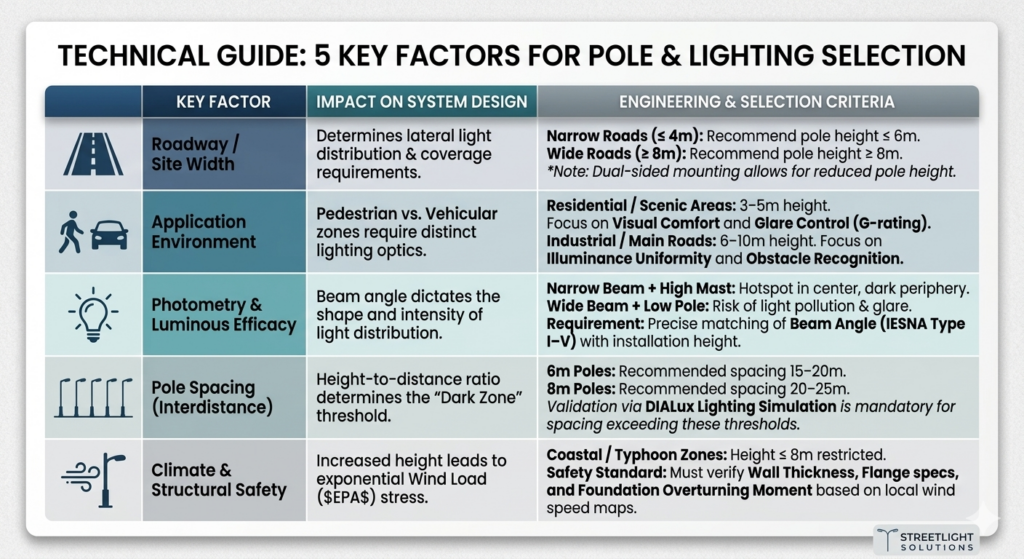
2. Five Key Factors to Consider Before Choosing Pole Height
2.1 Road Width or Site Width
This is the most basic factor.
If the road is narrow, such as a rural lane, residential branch road, or internal park road, an excessively tall pole is usually unnecessary. Since the road width is limited, a taller pole may increase cost without delivering proportional lighting value.
If the road is wide, such as a municipal road, two-way traffic lane, factory main road, or parking lot access road, a taller pole is usually needed to spread light more effectively across the full width.
A simple rule is this:
the wider the road, the higher the requirement for proper mounting height and optical distribution.
2.2 Whether the Area Is for Vehicles or Pedestrians
Different applications have different lighting priorities.
For pedestrian paths, garden walkways, scenic pathways, and internal residential roads, the main goals are visual comfort, softness, uniformity, and glare reduction. In these applications, lower pole heights are usually more appropriate.
For vehicle roads, parking lots, and industrial roads, the priority is greater visibility distance, roadway recognition, and larger coverage. In these cases, higher mounting heights are usually more appropriate.
So even when both are solar street lights, the correct solar street light pole height should not be the same for pedestrian and vehicle areas.
2.3 Lamp Wattage, Luminous Efficiency, and Beam Distribution
One of the most common mistakes buyers make is asking only, “How many watts?” instead of asking, “What pole height does this wattage match?”
In reality, the same wattage can produce very different results at different mounting heights.
For example, if a luminaire has a narrow beam distribution but is installed too high, the center area may be bright enough while the edge areas remain dark. If a luminaire has a wide beam distribution but is installed too low, it may cause excessive spill light, stronger glare, and lower lighting efficiency.
That is why solar street light pole height must always be matched with:
-
actual LED output
-
luminaire efficacy
-
beam distribution type
-
arm length and tilt angle
-
road width and installation arrangement
-
pole spacing
In other words, pole height is not an isolated parameter. It is part of the complete solar street light design.
2.4 Spacing Between Poles
This is something customers care about a lot, but it is often overlooked during early quoting.
Many people ask, “Why does one project use a 6-meter pole while another uses an 8-meter pole?”
Often, the reason is not simply to make the pole taller. It is to increase spacing, reduce pole quantity, and optimize the total project cost.
Generally speaking, a taller pole can provide wider coverage, so the spacing between two adjacent solar street lights can be increased to some extent. But if the spacing becomes too large, lighting uniformity will decrease and dark zones may appear between poles.
So the right way to evaluate a project is not to look only at pole height. It is to consider the following factors together:
Pole height + beam distribution + road width + pole spacing + target illuminance
Only when these parameters are considered together can you obtain a truly reliable solar street light design.
2.5 Local Climate, Wind Load, and Installation Conditions
The taller the pole, the higher the structural safety requirement. This is a critical engineering issue that should never be ignored.
Extra caution is needed when selecting taller poles for the following locations:
-
coastal areas
-
typhoon-prone regions
-
dusty or windy regions
-
open plazas or exposed roads
-
bridge decks, embankments, mountain passes, and other high-wind zones
As pole height increases, wind load becomes more significant. Pole wall thickness, diameter, flange size, foundation size, and overall structural strength may all need to be increased. Otherwise, a project may save some money in the beginning but create greater safety and maintenance risks later.
3. Recommended Solar Street Light Pole Height for Different Applications
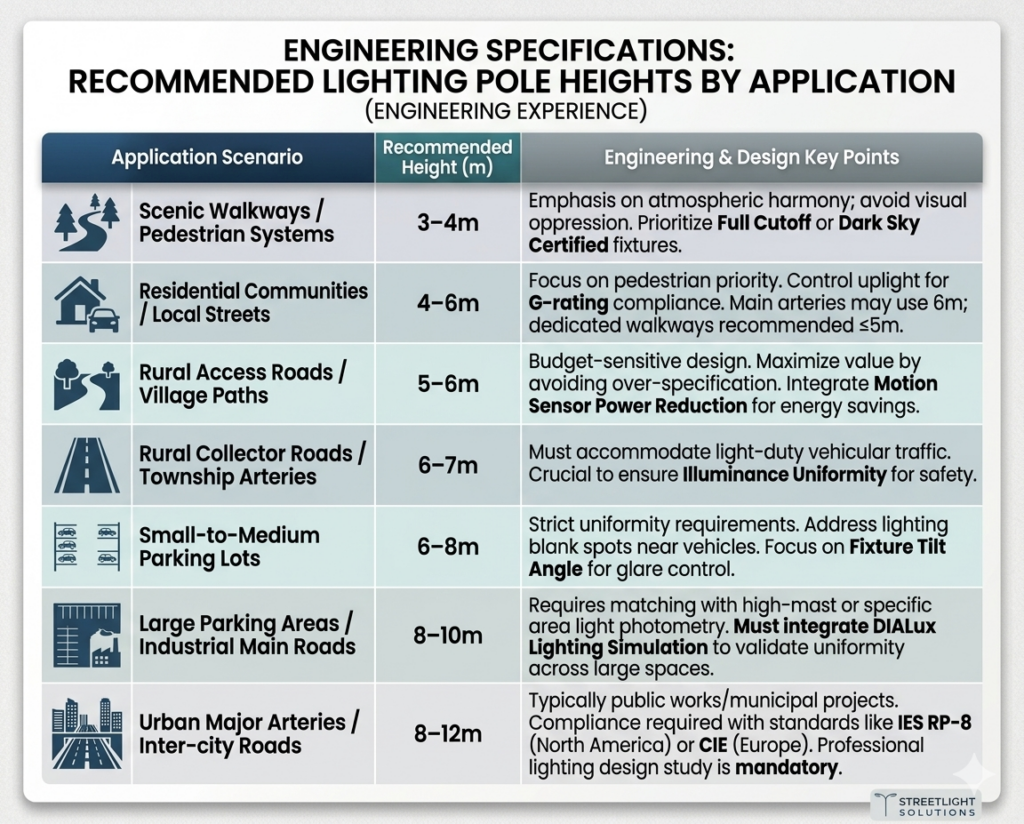
The following values are common engineering reference ranges for early-stage selection. Final design should still be confirmed according to local standards, road classification, target illuminance, and lighting simulation.
3.1 How to Choose Solar Street Light Pole Height for Rural Roads
Rural roads are usually not very wide, traffic speed is relatively low, and budgets are often sensitive. For this reason, most rural projects focus on practicality, durability, and cost control.
Typical recommendations are:
-
narrow roads, village roads, and small country roads: 5m to 6m
-
wider village main roads or township roads: 6m to 7m
The key in these projects is not to pursue maximum brightness blindly. The goal is to achieve:
-
sufficient basic illumination
-
reasonable spacing
-
stable operation during consecutive cloudy or rainy days
-
simple maintenance
-
no unnecessary oversizing caused by excessive pole height
3.2 Solar Street Light Pole Height for Residential Roads
Residential roads and community roads place more emphasis on comfort, softness, and glare control.
If the pole is too high, the space may feel visually empty. If the pole is too low, residents may feel the light is harsh or glaring.
For these applications, a common recommendation is:
-
4m to 6m
Lower heights are usually more suitable for pedestrian and landscape zones, while internal vehicle roads and main residential access roads may require slightly higher poles.
3.3 What Is the Right Solar Street Light Pole Height for Parking Lots?
Parking lots require wider lateral light coverage, and both vehicles and pedestrians need adequate visibility for turning, reversing, and circulation.
Typical recommendations are:
-
small and medium parking lots: 6m to 8m
-
larger parking areas: 8m and above, subject to lighting simulation and structural review
Parking-lot lighting design should also pay special attention to reducing uplight and glare through proper aiming and shielding. Responsible outdoor lighting guidance emphasizes directing light only where needed and minimizing glare and spill light.
3.4 Solar Street Light Pole Height for Industrial Roads and Factory Roads
Industrial roads generally require more functional lighting than residential roads because they may involve vehicle movement, loading operations, night shifts, and coordination with security monitoring.
Typical recommendations are:
-
ordinary factory branch roads: 6m to 8m
-
factory main roads or wider industrial passages: 8m to 10m
If large vehicles pass through the site, the road is wide, or monitoring visibility must also be considered, simply increasing lamp wattage is often not enough. In many cases, the pole height and beam distribution level must also be upgraded.
3.5 Solar Street Light Pole Height for Park Pathways and Scenic Walkways
These areas are usually not suitable for very tall poles because excessive height may weaken the landscape atmosphere and cause visual discomfort.
A more common choice is:
-
3m to 5m
If the project places emphasis on ecological protection, dark-sky friendliness, or landscape harmony, more attention should be paid to shielding and glare control.
4. What Happens If the Pole Height Is Wrong
Height-selection problems may become apparent after installation.
If the pole is too low, common problems include:
-
coverage area is too small
-
spacing between poles cannot be increased
-
more poles are required, increasing total project cost
-
pedestrians or drivers may feel stronger glare
-
larger road areas may not be lit uniformly
If the pole is too high, common problems include:
-
insufficient ground illuminance, especially outside the center area
-
the need for higher lamp wattage and a larger solar power storage system
-
larger battery, solar panel, and controller configuration
-
higher wind-resistance and foundation requirements
-
more difficult transportation and installation
-
total budget becoming difficult to control
So from a project perspective, the right height is neither the tallest nor the shortest one. It is the one that best matches the actual application.
5. The Relationship Between Pole Height, Wattage, Spacing, and System Configuration
Many customers ask these questions separately:
-
How many watts should be used on a 6-meter pole?
-
What spacing is suitable for an 8-meter pole?
-
How large should the solar panel be?
-
How large should the battery be?
In reality, none of these questions should be answered independently from solar street light pole height.
In a solar street light system, once pole height changes, the following parameters usually change as well:
-
lamp wattage
-
beam angle or distribution type
-
installation spacing
-
daily energy consumption
-
battery capacity (Solar Street Light Battery Capacity Calculation Guide)
-
solar panel size
-
backup capability during cloudy or rainy days
-
pole structural strength
That means pole height is one of the starting points of solar street light configuration design.
6. Six Questions Buyers Should Ask Suppliers
To avoid looking only at price and ignoring the actual lighting plan, buyers should ask suppliers these six questions directly:
6.1 How was this pole height selected?
Check whether the supplier selected the pole height based on real road width, spacing, and illuminance target, or whether they simply offered a configuration based on rough experience.
6.2 What beam distribution is matched to this pole height?
Many lighting failures happen not because the lamp is weak, but because the beam distribution is wrong.
6.3 What spacing is recommended at this height?
Pole height and spacing must always be evaluated together.
6.4 Has lighting simulation been done for this project?
For professional projects, it is strongly recommended to perform a basic lighting simulation using a professional lighting design tool such as DIALux, which is designed for standards-compliant indoor and outdoor lighting calculation and visualization.
6.5 Has the wind-resistance structure been checked at this height?
This is especially important for coastal, typhoon-prone, and high-wind regions.
6.6 Are the battery and solar panel sized according to this pole height and lamp power?
If not, the design is often not rigorous enough.
7. A Practical Way to Choose Solar Street Light Pole Height
Use the following decision sequence to organize the project inputs:
Step 1: Define the application scenario
Is it for a rural road, residential road, parking lot, urban main road, intercity main road, industrial road, or scenic pathway?
Step 2: Confirm road width and the main user type
Is the area mainly for pedestrians or for vehicles? How wide is the road? Is the lighting layout single-sided or double-sided?
Step 3: Determine a preliminary pole height range
Use practical reference values to narrow down the range first.
Step 4: Match lamp wattage and beam distribution to the selected height
Do not start with wattage first and guess the height later.
Step 5: Finalize spacing, battery, solar panel, and structural design
This produces a more reasonable and project-oriented solution.
8. Conclusion
There is no universal answer to the question of how to choose solar street light pole height. There is only the answer that is most suitable for a specific project.
The correct solar street light pole height should be determined according to the application scenario, road width, lighting target, installation spacing, luminaire optics, budget, and structural safety requirements.
For pedestrian pathways, landscape areas, and walkways, an excessively tall pole is usually unnecessary.
For normal roads, parking lots, and urban or intercity traffic roads, a higher mounting position is often needed to achieve wider coverage.
For windy, open, or wide-road environments, wind resistance and structural safety must also be treated as core design conditions.
A truly professional solar street light design does not only tell the customer the wattage and the price. It clearly explains:
-
why this pole height is selected
-
why this lamp wattage is matched
-
why this spacing is recommended
-
why this overall configuration is suitable for the project
Only in this way can the final project achieve the right brightness, reasonable cost, stable operation, and easier long-term maintenance.
If you are planning a solar street lighting project, you can explore our Solar Street Lighting Solutions page for more design guidance and product options.
Project Information Checklist
Send the following details for a faster and more accurate solar street light quotation:
Use the solar road lighting project guide to bring road width, layout, operating schedule, shading and maintenance access into one inquiry. Compare the solar street light purchasing page against those inputs; its configuration must be confirmed for your site. If panel positioning or battery access affects the selected pole arrangement, read the all-in-one and split-system comparison before requesting the final configuration.
- Project location (city/country)
- Required lamp wattage and daily working hours
- Pole height, pole spacing, and quantity
- Required backup days (autonomy days)
- Average sunshine hours or local solar irradiation data
- Required lighting standard or brightness expectation
- Whether poles, brackets, or foundations are included
- Shipping destination port
Existing article product links
Related Products
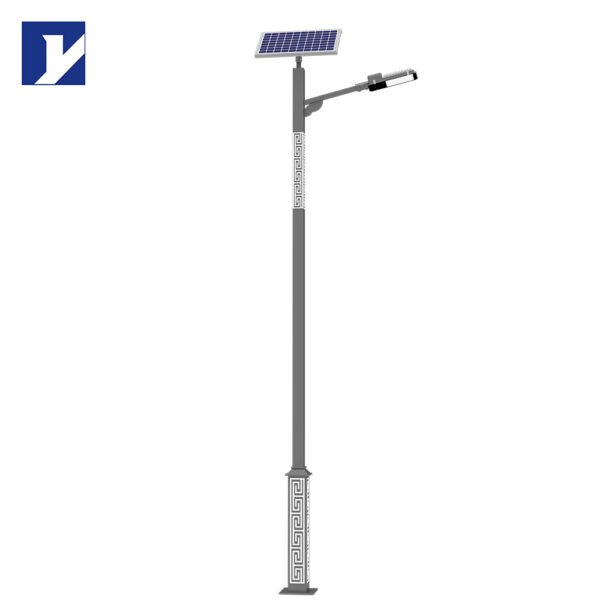
Additional Article Questions
How tall should a solar street light pole be for rural roads?
For most rural road projects, a solar street light pole height of 5m to 6m is commonly used for narrow roads, village roads, and small country roads. For wider village roads or township roads, 6m to 7m may be more appropriate. The final choice should still depend on road width, traffic conditions, lighting requirements, and spacing design.
What is the recommended solar street light pole height for residential roads?
For residential roads and community roads, the recommended solar street light pole height is usually 4m to 6m. Lower heights are more suitable for pedestrian paths, gardens, and landscape areas, while slightly higher poles may be used for internal vehicle roads or main residential access roads.
What is the right solar street light pole height for parking lots?
For parking lots, the recommended solar street light pole height is usually 6m to 8m for small and medium parking areas. Larger parking lots may require 8m or higher, depending on the lighting layout, beam distribution, and structural safety check. Parking lot lighting should also consider glare control and uniformity carefully.
How does solar street light pole height affect spacing between poles?
In general, a greater solar street light pole height allows for a larger spacing between poles because the light can cover a wider area. However, spacing cannot be increased without limit. If the poles are too far apart, uniformity may drop and dark areas may appear between fixtures. Pole height and spacing should always be designed together.
How does solar street light pole height affect battery and solar panel size?
The solar street light pole height affects lamp wattage selection, beam distribution, and lighting coverage, which in turn influence daily power consumption. Once energy demand changes, the required battery capacity and solar panel size may also change. That is why pole height should never be selected separately from the complete solar street light system configuration.
Is pole height more important than wattage in solar street light design?
Both are important, but solar street light pole height should be considered together with wattage rather than separately. A high-wattage lamp installed at the wrong height can still produce poor lighting results. A professional design always matches pole height, wattage, optics, spacing, and system sizing as one integrated solution.
Should different application scenarios use different solar street light pole heights?
Yes. Different scenarios usually require different solar street light pole heights. Pedestrian paths, scenic walkways, and landscape areas generally use lower poles. Residential roads use medium-height poles. Parking lots, industrial roads, and wider traffic roads often need taller poles to provide sufficient lateral coverage and better visibility.
Article-specific FAQ
What is the best solar street light pole height?
There is no single “best” solar street light pole height for every project. The right height depends on the application scenario, road width, lighting target, installation spacing, beam distribution, and structural safety requirements. For pedestrian paths, lower pole heights are usually more suitable, while roads, parking lots, and industrial areas often require taller poles for wider coverage.
How do I choose the right solar street light pole height for my project?
To choose the right solar street light pole height, you should first identify the application scenario, such as a rural road, residential road, parking lot, factory road, or park pathway. Then evaluate the road width, whether the area is mainly for vehicles or pedestrians, the required lighting coverage, and the expected pole spacing. After that, match the pole height with suitable lamp wattage, beam distribution, battery capacity, solar panel size, and wind-load requirements.
Does a higher solar street light pole always mean better lighting performance?
No. A higher solar street light pole height does not always mean better lighting. A taller pole can increase the lighting coverage area, but if the lamp wattage and optical distribution are not matched correctly, ground illuminance may decrease and dark zones may appear. Good lighting performance depends on proper matching between pole height, luminaire output, spacing, and beam angle.
What happens if the solar street light pole height is too low?
If the solar street light pole height is too low, the lighting coverage area becomes smaller, and the spacing between poles usually has to be reduced. This may increase the total number of poles required and raise the overall project cost. A low pole height can also increase glare if pedestrians or drivers are exposed to the light source directly.
What happens if the solar street light pole height is too high?
If the solar street light pole height is too high, the light may spread too widely and reduce ground-level brightness. This often requires higher lamp wattage, larger battery capacity, and larger solar panels to maintain the required illumination level. A taller pole may also increase wind-load requirements, structural cost, foundation size, transportation difficulty, and installation complexity.
Related Guides
 Solar Street Light vs Traditional LED Street Light: Which Is Better for Your Project?Solar Street Lighting Solutions / All-in-One Solar Street Lights→
Still unsure what solar street light pole height is right for your project?
Tell us your road width, application scenario, installation spacing, and brightness requirements. Our team will recommend a suitable solar street light pole height and matching system configuration for your project.