Maintenance of High Mast Lighting Systems
High mast lighting maintenance is a critical part of keeping tall outdoor lighting systems safe, reliable, and cost-effective over the long term. For highways, ports, airports, logistics yards, and large industrial sites,…
Updated 2026-10-21 · 13 min read
High mast lighting maintenance is a critical part of keeping tall outdoor lighting systems safe, reliable, and cost-effective over the long term. For highways, ports, airports, logistics yards, and large industrial sites, a clear maintenance plan helps reduce failures, improve lighting performance, and extend service life.
This guide explains what high mast lighting maintenance should include, how often systems should be inspected, which faults are most common, and when repair, retrofit, or full replacement becomes the better decision.
In practice, high mast lighting maintenance is not just about replacing failed luminaires. It includes structural inspection, electrical testing, lifting system checks, cleaning, fastener verification, corrosion assessment, and timely replacement of worn components, in line with established high mast lighting inspection and servicing guidance. For project owners managing busy traffic areas or heavy-duty operating environments, preventive maintenance is usually far more practical than waiting for faults to appear.
Key Takeaways
- Maintenance of High Mast Lighting Systems is essential for safety, lighting performance, and long-term cost control.
- A proper maintenance plan should cover structural inspection, electrical checks, luminaire cleaning, corrosion review, and lifting system inspection where applicable.
- Common issues in high mast lighting systems include luminaire failure, driver aging, wire rope wear, corrosion, loose fasteners, and electrical faults.
- Preventive maintenance helps reduce unexpected breakdowns, extend service life, and improve overall project reliability.
- High mast lighting systems in ports, highways, industrial yards, and coastal environments usually require more frequent inspection and servicing.
- Project owners should know when a system needs repair, when retrofit is the better option, and when full replacement is more economical.
1. Why Maintenance of High Mast Lighting Systems Matters
The first reason high mast lighting maintenance matters is safety.
A high mast lighting system is made up of multiple interdependent parts: the pole shaft, lantern carriage or luminaire ring, luminaires, internal cables, raising and lowering mechanism where applicable, wire ropes, pulleys, guiding devices, locking components, electrical distribution parts, and foundation connections. Because these systems are tall, exposed, and subject to wind, rain, dust, vibration, and temperature variation, even a small defect can develop into a bigger operational or safety problem if ignored.
The second reason is lighting quality.
Lighting design for highways, yards, ports, and public areas is based on target performance over time, not just the performance recorded on the first day of operation. Dust buildup, driver aging, optical contamination, connection issues, and fixture degradation all reduce actual lighting output. That means maintenance directly affects illumination uniformity, visibility, and the user experience on site.
The third reason is total lifecycle cost.
A planned service program costs money, but uncontrolled failure usually costs much more. Emergency repair work, equipment downtime, temporary access arrangements, traffic disruption, and premature replacement all increase the true cost of ownership. That is why experienced project teams treat maintenance as part of asset management, not as an occasional repair task.
2. Common Problems Found in High Mast Lighting Systems
Common issues found during high mast lighting maintenance usually fall into the following categories.
2.1 Luminaire and Driver Degradation
Over time, luminaires lose efficiency. LED modules can age, drivers can fail, seals can weaken, and optical components can become dirty or discolored. In harsh environments, moisture, insects, dust, or high heat can accelerate this process. The result is often reduced brightness, uneven lighting, or complete fixture failure.
2.2 Raising and Lowering System Wear
For lowering-type systems, the lifting assembly needs close attention. Wire ropes, winches, pulleys, guide arms, locking devices, and carriage components can wear over time. If these parts are not checked regularly, the system may become difficult to operate, fail to lock correctly, or show abnormal movement during servicing. In many cases, high mast lighting maintenance becomes more complex and costly simply because these wear items were ignored for too long.
2.3 Wire Rope Damage or Corrosion
Wire rope condition is one of the most critical maintenance points in lowering-type high mast systems. Broken wires, corrosion, kinks, flattening, distortion, or visible wear should never be dismissed. Once rope condition starts to deteriorate, the reliability of the whole lowering system is affected. This is why regular wire rope review should follow recognized wire rope inspection requirements rather than visual guesswork alone.
2.4 Pole Corrosion and Coating Damage
In coastal areas, ports, chemical zones, or high-humidity environments, corrosion often develops faster around the shaft surface, weld areas, access door openings, flange connections, and anchor bolt zones. If protective layers are damaged and not repaired in time, corrosion can spread and eventually affect structural integrity.
2.5 Loose Fasteners and Connection Problems
Wind vibration, thermal movement, and long-term service can loosen anchor bolts, luminaire mounting hardware, flange bolts, and other critical fasteners. If not identified early during high mast lighting inspection, this can lead to misalignment, increased vibration, or abnormal structural stress.
2.6 Electrical Faults
Typical electrical problems include cable aging, loose terminals, reduced insulation performance, water ingress in control gear, surge protection failure, poor grounding, and driver malfunction. These are common reasons why a system that looks mechanically sound may still show unstable lighting performance.
3. High Mast Lighting Maintenance Checklist
High mast lighting maintenance should follow a clear inspection checklist. In most projects, the scope should include the following items.
3.1 Structural and Visual Inspection
Check the pole shaft for visible deformation, impact damage, rust, coating failure, or abnormal movement. Inspect weld areas, access doors, stiffeners, flange zones, and exposed foundation connections. Look at anchor bolts, nuts, and washers to confirm that nothing is loose, missing, or heavily corroded.
3.2 Luminaire Ring and Fixture Inspection
Check whether the ring or carriage is level and properly positioned. Verify that all luminaires are securely fixed. Inspect lenses, covers, and optical surfaces for cracking, contamination, yellowing, or water ingress. Review the condition of drivers, connectors, and internal wiring. In many cases, simple cleaning is an important part of high mast lighting system service, because accumulated dust can noticeably reduce light output.
3.3 Raising and Lowering Mechanism Inspection
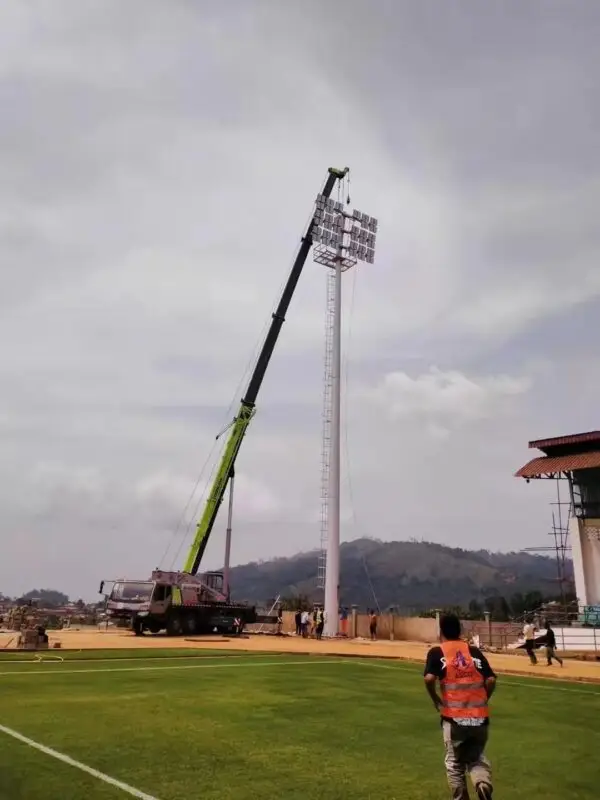
If the system is designed for lowering maintenance, inspect the winch, wire ropes, pulleys, guide components, and locking assembly. Confirm that the operation is smooth, stable, and repeatable. During servicing, the ring should lower and return correctly without abnormal noise, sticking, or misalignment. This is one of the most important parts of preventive maintenance for high mast lighting systems.
3.4 Electrical System Inspection
Check supply cables, terminals, protective devices, grounding, and control components. Test insulation where required. Verify that the control cabinet is sealed and that internal components are dry and secure. Inspect surge protection, timers, photocells, contactors, and drivers where applicable. Good high mast lighting troubleshooting always includes both the mechanical side and the electrical side.
3.5 Surface Protection and Corrosion Control
Inspect galvanizing, paint systems, and all exposed steel areas. If there is local coating damage, early repair is much easier than large-scale refurbishment later. In marine and industrial environments, this point deserves extra attention because corrosion can advance quickly once the protective layer is compromised.
4. Recommended Maintenance Schedule
A reactive approach is rarely the best approach. Maintenance should be planned in service intervals that match the site conditions and operational importance of the installation.
4.1 Routine Visual Checks
Routine site checks can be carried out during normal operations. These should focus on obvious signs of trouble, such as dark fixtures, tilted rings, physical damage, open access doors, or visible corrosion near the base and connection points.
4.2 Quarterly Condition Review
Every few months, it is good practice to carry out a more structured review. This may include checking cabinet condition, verifying operation of control gear, reviewing visible corrosion, and confirming that the system still performs normally after heavy wind or storm events.
4.3 Annual Detailed Inspection
At least once a year, a more thorough high mast tower inspection should be performed. This is the right time to assess structural connections, anchor bolts, electrical integrity, grounding, fixture condition, and the operating condition of the lifting mechanism if present. Annual checks are especially important in ports, highways, and industrial sites where the operating demands are higher. For owners managing this type of infrastructure, broader FHWA guidance on inspection and maintenance of structural supports for luminaires is also useful when building a formal maintenance program.
4.4 Periodic Major Servicing
For lowering-type systems, major servicing should be scheduled at suitable intervals based on environment, age, and usage conditions. This deeper service often includes lowering the ring, cleaning luminaires, inspecting moving parts, reviewing wire rope condition, checking locking components, and replacing worn items where necessary. In harsh environments, the interval should be shorter. In lower-risk inland environments, it may be longer. The key point is that maintenance should be based on actual operating conditions, not guesswork.
5. How Preventive Maintenance Reduces Lifecycle Cost
Some buyers still see maintenance as an extra expense. In reality, preventive work usually lowers the true cost of the system over time.
First, it prevents small issues from turning into major failures. A minor cable problem, an early-stage corrosion point, or a worn pulley component is usually manageable when caught early. Once ignored, the same issue can lead to system shutdown, access equipment cost, and more extensive replacement work.
Second, it reduces unplanned outages. In ports, highways, and logistics yards, lighting interruptions affect both safety and productivity. A consistent high mast lighting maintenance plan helps avoid these disruptions. This is also why buyers should look beyond initial price and review what really affects the price of high mast lighting poles in long-term project planning.
Third, it extends service life. A high mast installation is a major asset. Good maintenance helps protect that investment by preserving structural condition, electrical reliability, and lighting performance year after year.
6. When to Repair, Retrofit, or Replace
Not every problem should be handled in the same way. During maintenance, the right decision often falls into one of three paths: repair, retrofit, or replacement.
6.1 Repair
Repair is usually the right choice when the issue is local and the overall system is still in good condition. Typical examples include replacing a failed driver, tightening hardware, repairing local coating damage, changing a worn electrical component, or replacing a small number of luminaires.
6.2 Retrofit
Retrofit makes sense when the structure is still serviceable but system performance is no longer ideal. Common upgrade cases include replacing old luminaires with modern LED fixtures, improving optical performance, upgrading the control system, or improving energy efficiency. In many projects, retrofit is a better long-term decision than repeated short-term repair.
6.3 Replace
Replacement should be considered when the pole has severe corrosion, the foundation connection presents a structural risk, the raising and lowering mechanism is beyond economical repair, or the whole installation no longer meets current project requirements. A serious review during maintenance can help owners decide when replacement is justified instead of continuing to invest in an aging system.
7. How to Choose a Reliable Maintenance and Supply Partner
High mast systems are specialized products. They are taller, more exposed, and more technically demanding than many standard lighting installations. That is why maintenance should be handled by a team that understands not just lighting fixtures, but also pole structures, corrosion protection, lifting systems, and project-based operating environments.
A reliable partner should be able to support the project with practical knowledge in the following areas:
high mast pole structure and fabrication
luminaire selection and lighting distribution
raising and lowering mechanism components
galvanizing and anti-corrosion protection
spare parts planning
maintenance recommendations for local conditions
retrofit and replacement planning for aging systems
For contractors, municipalities, ports, airports, and industrial operators, it is usually better to work with a supplier that can support both the product side and the maintenance side. That approach makes future servicing easier and improves continuity over the life of the project. You can also review selected project references to understand how similar lighting systems are used across different markets and applications.
8. Practical Advice for Project Owners
If you are responsible for a high mast installation, one of the best steps you can take is to create a basic maintenance record for each pole. This does not need to be complicated. A practical record can include installation date, luminaire model, operating area, inspection history, known issues, replaced parts, and the next planned service date.
This simple habit makes maintenance more consistent and much easier to manage, especially when there are multiple towers across a large site.
It is also wise to keep a small stock of critical spare parts where possible. Depending on the project, that may include drivers, surge protectors, connection hardware, and selected components for the lowering mechanism. For large or remote projects, this can significantly reduce downtime.
9. Conclusion
Maintenance is not just a technical afterthought. It is a practical strategy for protecting safety, preserving lighting performance, and controlling long-term cost.
A high mast system works as a complete assembly. The pole structure, luminaires, electrical parts, protective finishes, and lowering mechanism all need attention over time. When project owners follow a planned maintenance approach instead of waiting for failure, the result is usually better reliability, lower risk, and a more stable return on investment.
For highways, ports, airports, industrial yards, and large outdoor areas, a well-executed maintenance plan is one of the clearest signs of professional asset management.
Maintenance Planning Checklist
If you are planning inspection, maintenance, repair, or retrofit work for a high mast lighting system, preparing the following information will help your supplier or engineering team give more practical recommendations.
Before requesting a new system, compare fixed and lowering-ring maintenance arrangements. The 20m motorized high mast product page provides a current purchasing reference; it does not establish compatibility with an installed mast. For existing equipment, send its identification, drawing revision, inspection record and observed fault. Use the high mast procurement guide when preparing a replacement inquiry, and confirm component compatibility before ordering.
- Current pole height and approximate installation year
- Application environment (highway, port, airport, industrial yard, logistics area, parking lot, etc.)
- Whether the system is fixed head or raising and lowering type
- Current problems observed on site (lamp failure, corrosion, lowering system issues, cable wear, vibration, etc.)
- Whether the luminaires and drivers are original or previously replaced
- Condition of the wire rope, pulleys, winch, and locking components
- Visible corrosion on the pole shaft, base plate, welds, or fasteners
- Frequency of past inspections and maintenance records, if available
- Whether spare parts or replacement components are still available
- Whether you need inspection advice, repair support, retrofit recommendations, or full replacement evaluation
Existing article product links
Related Products
Article-specific FAQ
What is included in Maintenance of High Mast Lighting Systems?
It usually includes structural inspection, luminaire checks, electrical testing, cleaning, corrosion assessment, fastener verification, and inspection of the raising and lowering mechanism where applicable.
How often should high mast lighting systems be inspected?
That depends on the environment, usage level, and project requirements. Most sites benefit from routine visual checks, periodic condition reviews, and at least one detailed annual inspection.
Why is preventive maintenance important for high mast lighting systems?
Preventive work helps identify wear, corrosion, electrical faults, and lifting system issues before they become major failures. It also improves reliability and reduces long-term repair cost.
When should a high mast lighting system be retrofitted instead of repaired?
Retrofit is often the better option when the structure is still sound but the luminaires, control system, or energy performance are outdated.
Does the environment affect high mast lighting maintenance requirements?
Yes. Coastal zones, ports, industrial areas, and dusty environments usually require more frequent inspection and servicing because corrosion and contamination progress faster in those conditions.
Related Guides
Need Support for High Mast Lighting Maintenance or Upgrade?
Qiyao Infra provides project-based support for high mast lighting systems, including customized pole structures, luminaire configuration, spare parts planning, and long-term maintenance recommendations for highways, ports, industrial yards, airports, and other large outdoor applications.
Contact our team to discuss inspection, retrofit, replacement, or new project requirements.