What Affects the Price of High Mast Lighting Poles?
In airports, highway interchanges, toll stations, ports, logistics parks, large parking lots, industrial plants, urban squares, and sports perimeter areas, high mast lighting poles are one of the most widely used lighting…
Updated 2026-10-21 · 23 min read
In airports, highway interchanges, toll stations, ports, logistics parks, large parking lots, industrial plants, urban squares, and sports perimeter areas, high mast lighting poles are one of the most widely used lighting solutions. Compared with ordinary street light poles, they provide wider coverage, fewer ground pole positions, and more centralized maintenance, which makes them especially suitable for large-area engineering projects. In lighting practice, high mast lighting generally refers to a system in which multiple luminaires are mounted at the top of a tall pole to illuminate a large outdoor area, typically at mounting heights above about 20 meters.
However, in real procurement, many buyers face the same question: why can the price of high mast lighting poles vary so much even when the specifications seem similar?
Some buyers see a “30-meter high mast lighting pole” and assume that quotations from different suppliers should be close. But experienced contractors, project owners, and engineering buyers know that even for the same nominal height, the price of high mast lighting poles can differ significantly. That is because a high mast system is never just a steel pole. It is a complete engineering product involving structural safety, top load, wind resistance, foundation conditions, corrosion protection, maintenance method, transportation, installation, and project documentation requirements.
From a professional point of view, the price of high mast lighting poles is not determined by steel weight alone, and it certainly cannot be judged simply by asking “how much per ton?” Guidance from FHWA on highway signs, luminaires, and traffic signal support structures highlights that long-term performance depends not only on static strength, but also on wind load, vibration, fatigue, fabrication details, inspection, and maintenance. That is why differences in the price of high mast lighting poles are often really differences in engineering scope, safety margin, and lifecycle reliability.
Key Takeaways
- The price of high mast lighting poles is shaped by structure, safety, maintenance, corrosion protection, transport, and documentation requirements, not by pole height alone.
- Pole height is important, but top load, wind load, foundation requirements, and maintenance method often have an even greater impact on the final high mast lighting pole price.
- For real projects, the correct way to compare the price of high mast lighting poles is to compare quotations on the same technical basis.
- The cheapest quotation is not always the most economical solution over the full service life of the project.
- Buyers should evaluate total ownership cost, not just the initial purchase price.
1. Why the Price of High Mast Lighting Poles Cannot Be Judged by Height Alone
The main cost categories are:
Price = structural cost + top load cost + corrosion protection cost + maintenance system cost + foundation adaptation cost + quality/documentation cost + logistics/service cost
In other words, what the customer is really buying is not an empty pole, but a complete outdoor lighting support system.
That system must answer several practical questions:
Can it achieve the required mounting height and lighting coverage?
Can it resist the local wind load and environmental conditions?
Can it operate reliably for many years?
Is maintenance safe and efficient?
Does it meet project standards, consultant requirements, or international tender requirements?
Is it suitable for transportation, installation, and jobsite execution?
That is why professional buyers should never compare the price of high mast lighting poles by unit price alone. A lower number on paper may simply mean a lower steel grade, lighter flange, thinner galvanizing layer, reduced documentation, or a less reliable raising and lowering system. A higher price may reflect a more complete engineering scope and better lifecycle value.
2. Pole Height: The Most Visible Pricing Factor
Pole height is the most obvious variable in the price of high mast lighting poles.
Common high mast pole heights include 20m, 25m, 30m, 35m, and 40m, with even taller structures used in some special applications. In general lighting and infrastructure terminology, high mast lighting is associated with tall poles designed to support multiple luminaires for large-area illumination.
Many buyers assume that if the pole height increases by 5 meters, the cost simply increases by the price of one more steel section. In reality, the price of high mast lighting poles usually rises faster than the height itself.
2.1 Height Increase Means Structural Upgrade, Not Just Extra Length
When a pole goes from 20 meters to 30 meters, the change is not just about adding 10 meters of steel plate. The bottom diameter usually has to increase, the wall thickness often has to increase, the taper ratio may need to change, and the section connection design may become more demanding.
As height increases, the bending moment at the base becomes much larger. That means the lower sections of the pole usually become significantly heavier and more structurally demanding.
2.2 Taller Poles Are More Sensitive to Wind
A high mast pole is a slender tall structure. The taller it is, the more sensitive it becomes to wind action on both the pole itself and the luminaires at the top. FHWA guidance on support structures emphasizes that wind effects, vibration response, and fatigue must be considered as part of long-term structural reliability.
This is one major reason why two quotations for a “30-meter high mast lighting pole” can be very different. They may not be designed to the same wind condition, the same fatigue expectations, or the same safety margin.
2.3 Greater Height Also Increases Manufacturing and Installation Difficulty
As pole height increases, projects often require:
-
more sections
-
longer or heavier individual sections
-
more demanding slip-joint or flange connections
-
more difficult welding and straightness control
-
more challenging galvanizing process control
-
more complex lifting and erection planning
These are real cost drivers in the final price of high mast lighting poles, even if they are not obvious from a simple dimension list.
3. Top Load: One of the Biggest Hidden Factors in High Mast Lighting Pole Price
In many projects, top load is one of the most underestimated factors behind the price of high mast lighting poles.
Top load includes much more than luminaire weight alone. It may include:
-
the luminaires themselves
-
the lantern ring or lighting platform
-
brackets and connection arms
-
cables and accessories
-
parts of the raising and lowering system
-
the effective projected area exposed to wind
For a high mast structure, top load directly affects the bending moment, wind force, and structural demand on the pole.
3.1 More Luminaires Usually Mean a Higher Price of High Mast Lighting Poles
Typical high mast systems may carry 4, 6, 8, 12, or 16 luminaires, and sometimes more.
As the luminaire quantity increases, the following usually increase as well:
-
total dead load at the top
-
lantern ring size
-
bracket complexity
-
effective wind area
-
force transferred to the pole, flange, and anchor system
So when a client adds more luminaires, the change is not limited to lighting equipment cost. It may also increase the structural price of high mast lighting poles.
3.2 Luminaire Type Also Matters
Different projects may use:
-
general LED area lighting luminaires
-
high-power floodlights
-
port and yard lighting fixtures
-
sports perimeter luminaires
-
smart control luminaires with segmented switching or dimming
For roadway and area lighting equipment, the ANSI C136 family covers several aspects of luminaire design and application, including high-mast-related equipment considerations. This reinforces an important procurement principle: luminaires must match the application, not just the wattage target.
3.3 Top Load Also Affects Maintenance Method
When the lantern ring is large and the luminaire quantity is high, the system is more likely to require a raising and lowering mechanism or a more specialized maintenance approach. That additional maintenance system will directly affect the price of high mast lighting poles.
4. Wind Load and Project Location
If pole height determines the base level of pricing, wind load and site environment often determine the upper range of the price of high mast lighting poles.
4.1 The Same Pole Height Can Have Very Different Prices in Different Locations
A 30-meter high mast lighting pole for an inland industrial site is not the same as a 30-meter pole for a coastal port, typhoon-prone zone, or exposed highway interchange.
Structural requirements usually increase in places such as:
-
coastal salt-spray zones
-
typhoon-prone regions
-
ports and terminals
-
exposed parking lots
-
highway interchanges
-
high-altitude windy areas
-
airports and open logistics yards
FHWA material on support structures makes it clear that environmental loading, vibration, inspection, and fatigue are major engineering concerns for these types of structures.
4.2 Wind Load Affects the Entire System, Not Just Pole Thickness
When wind load increases, the following may all need to be upgraded:
-
pole base diameter
-
pole wall thickness
-
flange size and thickness
-
anchor bolt diameter, grade, and quantity
-
stiffener design
-
weld requirements
-
foundation size and reinforcement
-
lantern ring and top support configuration
So wind load does not just “make the pole thicker.” It can raise the price of high mast lighting poles across the whole system.
4.3 Fatigue Performance Separates Engineering-Grade Products from Low-Cost Alternatives
A high mast lighting structure does not resist only one extreme wind event. It is also subjected to repeated wind action over many years. In long-service projects such as roads, ports, airports, and industrial facilities, fatigue resistance and connection reliability are critical parts of long-term value. That is one reason why the price of high mast lighting poles in serious engineering projects is often higher than low-budget market quotations.
5. Steel Grade, Pole Diameter, and Wall Thickness
Steel is one of the most direct cost components in the price of high mast lighting poles, but buyers should not evaluate it by steel tonnage alone.
5.1 Pole Diameter and Wall Thickness Directly Influence Cost
A larger bottom diameter and thicker wall section naturally require more material. In most high mast poles, the lower sections carry the greatest moment and therefore contain the highest steel cost concentration.
5.2 Steel Grade Also Changes the Price of High Mast Lighting Poles
Some projects accept common structural steel grades, while others require higher mechanical properties, specified yield strength, impact performance, or compliance with a particular national material standard. ASTM’s steel standards framework makes it clear that steel is not a single universal commodity; different grades and product standards exist for different applications and performance levels.
A higher steel grade may increase:
-
raw material cost
-
welding process requirements
-
traceability and certification requirements
-
fabrication quality control effort
5.3 Heavier Is Not Always Better, and Lighter Is Not Always More Advanced
Some buyers compare only total weight. That can be misleading.
-
One supplier may design conservatively and produce a heavier but safer structure.
-
Another may optimize the structure efficiently and reduce unnecessary steel use.
-
Another may simply reduce wall thickness, flange size, or stiffening to cut cost.
The right question is not “which pole is heavier?” but “is this design balanced in safety, economy, manufacturability, and service life?”
6. Corrosion Protection and Galvanizing Requirements
Corrosion protection is a major factor in the price of high mast lighting poles and in their service life.
Because high mast poles are exposed to sun, rain, temperature variation, humidity, pollution, and sometimes salt spray, corrosion control is not optional. It is part of core engineering quality.
6.1 Hot-Dip Galvanizing Is the Standard Baseline for Many Steel High Mast Poles
For fabricated steel structures, ASTM A123/A123M covers hot-dip galvanizing requirements for iron and steel products, including many types of welded structural components.
That means galvanizing is not just a cosmetic coating. It is a standardized protective process closely tied to fabrication quality and long-term performance.
6.2 Not All “Galvanized” Poles Are Equal
The actual cost and quality of galvanizing depend on factors such as:
-
required zinc coating thickness
-
suitability of the component for galvanizing
-
vent and drain hole design
-
weld quality and internal cavity handling
-
surface preparation
-
post-galvanizing finishing and repair
These differences can directly affect both the price of high mast lighting poles and the expected corrosion resistance.
6.3 Harsh Environments Usually Require More Than Basic Protection
In ports, coastal zones, islands, and chemical or industrial environments, a project may require:
-
hot-dip galvanizing plus powder coating
-
hot-dip galvanizing plus paint system
-
stricter coating inspection
-
longer anti-corrosion design life
That is why the price of high mast lighting poles for marine or high-corrosion projects is often noticeably higher than for standard inland applications.
7. Raising and Lowering Systems and Maintenance Strategy
One of the most overlooked contributors to the price of high mast lighting poles is the maintenance system.
7.1 High Mast Maintenance Is Very Different from Ordinary Street Light Maintenance
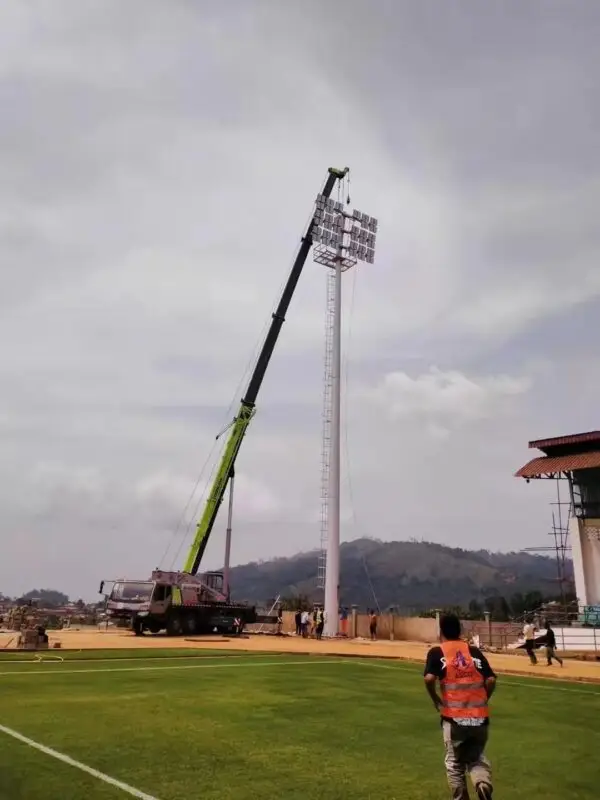
At 20m, 25m, 30m, or higher, maintenance becomes a serious operational issue. If every repair requires aerial work platforms, special lifting vehicles, traffic control, or high-risk climbing work, the operating cost can become significant.
That is why many high mast systems use a raising and lowering mechanism so the lantern ring can be brought down to ground level for maintenance.
7.2 A Raising and Lowering System Can Add Significant Cost
A complete system may include:
-
manual or motorized winch
-
wire rope system
-
pulleys and guide assemblies
-
limit devices
-
locking mechanism
-
anti-fall safety device
-
power cable arrangement
-
maintenance accessories
These are not simple add-ons. They are core functional components tied directly to maintenance safety and lifecycle usability. Naturally, they affect the price of high mast lighting poles.
7.3 A Cheap Initial Solution May Shift Cost to the Future
Some low quotations look attractive because they exclude or simplify:
-
raising and lowering systems
-
safety locking systems
-
access convenience
-
maintenance accessories
-
replacement planning
For airports, highways, ports, and continuously operating industrial facilities, the later maintenance burden can easily outweigh a lower initial high mast lighting pole price.
8. Foundation Conditions and Civil Interface
A high mast lighting pole cannot be evaluated independently from its foundation.
8.1 Foundation Conditions Can Change the Real Project Cost Substantially
Different sites may involve:
-
normal soil
-
fill soil
-
soft ground
-
high groundwater table
-
rock layer
-
underground utility restrictions
-
limited excavation space near existing roads or structures
These factors can change foundation size, embedment depth, reinforcement, anchor cage design, and installation difficulty.
8.2 Quotation Scope Differences Often Cause Misunderstanding
In practice, quotations may cover very different scopes:
-
pole only
-
pole + lantern ring + anchor bolts
-
full lighting system excluding civil works
-
embedded parts included but no concrete work
-
full turnkey supply and installation
So if two quotations look very different, it may not mean the suppliers are pricing the same thing. Buyers comparing the price of high mast lighting poles should always confirm whether anchor bolts, embedded parts, installation guidance, freight, and commissioning are included.
9. Fabrication Quality and Quality Control Documentation
Fabrication quality is another key reason why the price of high mast lighting poles can vary between suppliers even when headline dimensions appear similar.
9.1 Manufacturing a High Mast Pole Is a Serious Steel Fabrication Process
Typical production steps may include:
-
steel plate cutting
-
forming tapered sections
-
longitudinal welding
-
circumferential weld processing
-
flange machining and welding
-
stiffener fabrication
-
lantern ring fabrication
-
service door and accessory installation
-
trial fitting and dimensional inspection
-
surface treatment
-
packing and dispatch
Each of these stages affects final quality.
9.2 Weld Quality Is Critical to Long-Term Reliability
For tall outdoor support structures exposed to repeated wind action, weld quality matters greatly. Weld detail, flange connection quality, straightness control, and fabrication consistency all affect long-term performance. FHWA guidance repeatedly emphasizes fabrication detail, inspection, and maintenance as important parts of structural reliability.
9.3 Documentation and Inspection Requirements Also Increase Price
Large international, government, or EPC projects may require:
-
mill certificates
-
material traceability
-
dimensional inspection reports
-
galvanizing inspection records
-
welding procedure or inspection records
-
trial assembly records
-
packing lists and installation instructions
-
third-party inspection cooperation
These items are part of deliverable quality, and they directly influence the price of high mast lighting poles.
10. Transportation, Packaging, and Installation Conditions
High mast poles are large, long, and heavy products. That makes transport and installation important pricing factors.
10.1 Section Design Influences Logistics Cost
A high mast pole is usually divided into several sections for transport and site assembly. Section count alone does not determine the best arrangement.
The section design should balance:
container or truck transport suitability
section lifting weight
erection convenience
flange connection versus slip-joint preference
coating protection during shipping
This is another reason why the price of high mast lighting poles should not be judged by steel weight alone.
10.2 Export Projects Usually Need Better Packaging
For overseas shipment, projects often need:
-
flange face protection
-
galvanized surface protection
-
categorized accessory packing
-
clear part numbering
-
installation documents
-
moisture and abrasion prevention
All of these may affect the final price of high mast lighting poles.
10.3 Installation Conditions Can Also Raise Cost
If the project requires:
-
special lifting equipment
-
night work
-
work in high-risk areas
-
remote-site technical guidance
-
on-site support
-
commissioning service
then the quoted price of high mast lighting poles may increase even when the product itself is similar.
11. Lighting Design and Luminaire Configuration
Although buyers sometimes separate “pole price” from “lighting price,” the two often influence each other in practice.
11.1 Higher Lighting Targets Usually Mean Heavier System Demands
If a project requires higher illuminance, better uniformity, or broader edge coverage, it may need:
-
more luminaires
-
higher wattage
-
a larger lantern ring
-
more complex aiming and bracket layout
As soon as the top lighting configuration becomes larger or heavier, the structural price of high mast lighting poles often increases as well.
11.2 Luminaire Shape and Wind Area Matter Too
Many buyers focus only on wattage, but luminaire dimensions and wind exposure are also important. Large floodlights can significantly increase wind area at the top of the structure, which in turn affects structural demand and pricing.
11.3 Maintenance Strategy Can Influence Luminaire Choice
If a project aims to minimize maintenance frequency, it may prefer higher-grade luminaires with better drivers, longer service life, and stronger environmental resistance. Those products may cost more initially but may reduce total lifecycle cost.
12. Standards, Certifications, and Technical File Requirements
Standards and technical documentation can significantly affect the price of high mast lighting poles.
12.1 Some Buyers Want Only a Product, Others Need a Full Engineering Package
Some procurement cases are simple and focus only on height, power, and quantity. But many infrastructure projects, especially municipal, airport, port, and EPC projects, may require:
-
design basis statement
-
structural calculations
-
material description
-
corrosion protection specification
-
luminaire technical data
-
installation instructions
-
inspection reports
-
third-party inspection support
12.2 Higher Compliance Requirements Mean Higher Technical Cost
For high mast projects, relevant technical references commonly come from different areas:
-
IES for lighting application terminology and practice
-
ANSI/NEMA C136 for roadway and area lighting equipment context
-
ASTM A123 for hot-dip galvanizing requirements
-
FHWA for structural reliability, inspection, fatigue, and maintenance considerations
These references do not replace one another. Together, they reflect the multi-disciplinary engineering background behind the price of high mast lighting poles.
13. Why Some High Mast Lighting Pole Prices Look Unusually Low
In many cases, an unusually low price of high mast lighting poles may come from one or more of the following:
13.1 Reduced Main Pole Specification
Examples include:
-
smaller base diameter
-
thinner wall thickness
-
faster taper
-
lighter flange
-
reduced stiffeners
-
less robust section design
13.2 Lower Structural Reserve at the Top
Lantern ring and support details may be made lighter, which can reduce long-term stability.
13.3 Lower Corrosion Protection Level
The galvanizing process may be simplified, zinc coating may be lighter, or fabrication details may not support good coating quality.
13.4 Key Items or Services May Be Excluded
A low quotation may omit:
-
anchor bolts
-
lantern ring
-
luminaire brackets
-
cables
-
control cabinet
-
freight
-
installation guidance
-
commissioning
-
inspection and documentation
13.5 The Design Basis May Not Match the Real Project Environment
For example, a coastal windy project may be quoted as if it were an ordinary inland site.
That is why professional comparison of the price of high mast lighting poles must always be based on the same technical scope.
14. What Buyers Should Prepare Before Requesting a Quotation
If buyers want a more accurate and more comparable high mast lighting pole price, they should ideally prepare the following information.
14.1 Basic Project Information
-
project country and city
-
application: airport, port, square, parking lot, logistics yard, industrial zone, or highway
-
planned pole height
-
required quantity
14.2 Lighting Configuration
-
number of luminaires per pole
-
approximate wattage per luminaire
-
floodlight or roadway/area lighting type
-
smart control or segmented switching requirements
-
fixed or raising-and-lowering lantern ring
14.3 Environmental Conditions
-
basic wind speed or wind zone
-
coastal or inland
-
corrosion category
-
temperature, dust, or harsh-weather conditions
-
open exposed area or sheltered site
14.4 Scope of Supply
-
pole only
-
pole + lantern ring
-
pole + lantern ring + luminaires
-
anchor bolts included or not
-
embedded parts included or not
-
freight included or not
-
installation guidance included or not
14.5 Documentation Requirements
-
structural calculations
-
lighting simulation
-
third-party inspection
-
material and galvanizing reports
-
drawing development or project-specific detailing
The more complete the input, the more realistic the price of high mast lighting poles will be.
15. How to Evaluate Whether a High Mast Lighting Pole Price Is Reasonable
To judge whether a quotation is reliable, buyers should review at least five points.
15.1 Is the Design Basis Clear?
Check whether the quotation clearly states:
-
pole height
-
luminaire quantity
-
top load
-
design wind condition
-
material grade
-
corrosion protection method
15.2 Is the Scope of Supply Clear?
Confirm whether it includes:
-
main pole
-
lantern ring
-
luminaire brackets
-
raising and lowering system
-
anchor bolts
-
cables and accessories
-
packaging and freight
-
installation guidance
15.3 Does It Consider Maintenance?
The proposal should explain both how the system is made and how it will be maintained.
15.4 Does It Match the Project Environment?
Not every high mast lighting solution is suitable for every site. A coastal windy port project, an inland industrial plant, and a standard parking lot may need very different designs.
15.5 Does the Supplier Have Complete Delivery Capability?
That includes:
-
drawings
-
calculation support
-
documentation
-
inspection cooperation
-
export packaging
-
after-sales technical support
In real projects, these factors are often part of a reasonable price of high mast lighting poles.
16. Final Thoughts
The price of high mast lighting poles is never determined by one parameter alone.
In most real projects, the key factors include:
-
pole height
-
luminaire quantity and top load
-
wind load and site environment
-
steel grade, diameter, and wall thickness
-
flange, anchor, and foundation requirements
-
galvanizing and corrosion protection
-
raising and lowering system
-
fabrication quality and inspection control
-
transportation and installation conditions
-
standards, certification, and technical file requirements
So the right procurement question is not:
“What is your lowest price for a high mast pole?”
It is:
“For my project conditions, what high mast lighting solution offers the right balance of safety, functionality, durability, and lifecycle value?”
That is the real way to evaluate the price of high mast lighting poles professionally.
If you are sourcing high mast systems for airports, highways, ports, industrial zones, parking lots, or large infrastructure projects, it is best to define the project height, luminaire quantity, wind condition, corrosion level, maintenance method, and scope of supply before comparing quotations. Only then can the price of high mast lighting poles be compared on a truly meaningful basis.
We can help review your project conditions, identify what is really affecting the price of high mast lighting poles, and recommend a more suitable configuration for your specific application.
Project Information Checklist
Send the following details for a faster and more accurate high mast lighting quotation:
Compare the 20m motorized high mast option with the independent 30m high mast inquiry page only after defining the site and required configuration. Neither page is a fixed price list. Ask each quotation to identify the mast, luminaires, maintenance arrangement, anchor bolts, freight and installation responsibilities separately; confirm what is included and excluded. Review the maintenance planning guide alongside the initial equipment cost.
- Project location (city/country)
- Application scenario (airport, port, highway, parking lot, industrial area, etc.)
- Required pole height and quantity
- Number of luminaires per pole and wattage range
- Fixed or raising and lowering system required
- Basic wind speed or local wind load requirement
- Corrosion protection requirement (galvanized only or additional coating)
- Whether anchor bolts, foundation parts, or installation guidance are included
- Destination port or delivery address
Existing article product links
Related Products
Additional Article Questions
Does galvanizing quality affect the price of high mast lighting poles?
Yes. Hot-dip galvanizing is a major part of long-term corrosion protection for steel high mast poles. A higher galvanizing standard, thicker zinc coating, better surface preparation, and stricter inspection requirements will usually increase initial price, but they can also improve service life and reduce future maintenance costs.
Is a raising and lowering system necessary for every high mast lighting pole?
Not always. Some projects use fixed lantern rings, especially when maintenance access can be arranged by lifting equipment. However, for taller poles and projects that require safer and more efficient maintenance, a raising and lowering system is often preferred. This type of system adds cost, but it can reduce maintenance difficulty over time.
Why are some high mast lighting pole quotations much lower than others?
A lower quotation may mean the supplier is using lighter structural specifications, lower corrosion protection standards, fewer accessories, or a different scope of supply. In some cases, anchor bolts, lantern rings, freight, installation guidance, or technical documents may not be included. That is why quotations should always be compared on the same technical basis.
What information should I provide to get an accurate high mast lighting pole quotation?
To get a more accurate quotation, it is best to provide the project location, application type, required pole height, luminaire quantity and wattage, wind condition, corrosion protection requirement, maintenance preference, and scope of supply. The clearer the project information is, the easier it is to receive a realistic and comparable quotation.
Should I choose the lowest price for a high mast lighting pole project?
Not necessarily. The lowest initial price is not always the most economical option in the long run. For high mast lighting projects, buyers should also consider structural reliability, corrosion protection, maintenance convenience, documentation completeness, and expected service life. A more balanced solution often provides better total project value.
Article-specific FAQ
Why can the price of high mast lighting poles vary so much?
The price of high mast lighting poles can vary significantly because the system is not just a steel pole. It also depends on pole height, luminaire quantity, top load, wind load, steel grade, wall thickness, galvanizing standard, maintenance system, foundation requirements, transport conditions, and documentation scope. Two poles with the same nominal height may have very different structural specifications and lifecycle value.
What is the biggest factor affecting high mast lighting pole price?
There is no single factor that determines the price of a high mast lighting pole. In most projects, the biggest factors are usually pole height, top load, wind load, and corrosion protection requirements. For some airport, port, or coastal projects, maintenance systems and technical documentation can also have a major impact on price.
Does a taller high mast lighting pole always cost much more?
In most cases, yes. As pole height increases, the structure usually requires a larger bottom diameter, thicker wall sections, stronger flange connections, and more demanding fabrication and installation work. That is why the price of high mast lighting poles usually increases faster than height alone.
How does wind load affect the price of high mast lighting poles?
Wind load affects much more than pole thickness. It can influence the pole diameter, wall thickness, flange size, anchor bolt specification, stiffener design, lantern ring structure, and even the foundation design. In coastal, typhoon-prone, or highly exposed areas, wind load is often one of the main reasons for a higher quotation.
Do more luminaires always mean a higher high mast lighting pole price?
Usually yes. More luminaires increase the total dead load and wind-exposed area at the top of the structure. This can require a larger lantern ring, stronger brackets, and a more robust pole design. In many cases, adding luminaires increases both lighting system cost and structural cost.
Related Guides
Still unsure what affects the price of high mast lighting poles for your project?
Tell us your project location, required pole height, luminaire configuration, wind load condition, and corrosion protection requirement. Our team can help you identify the key pricing factors and recommend a high mast lighting pole solution that is more suitable for your project.